

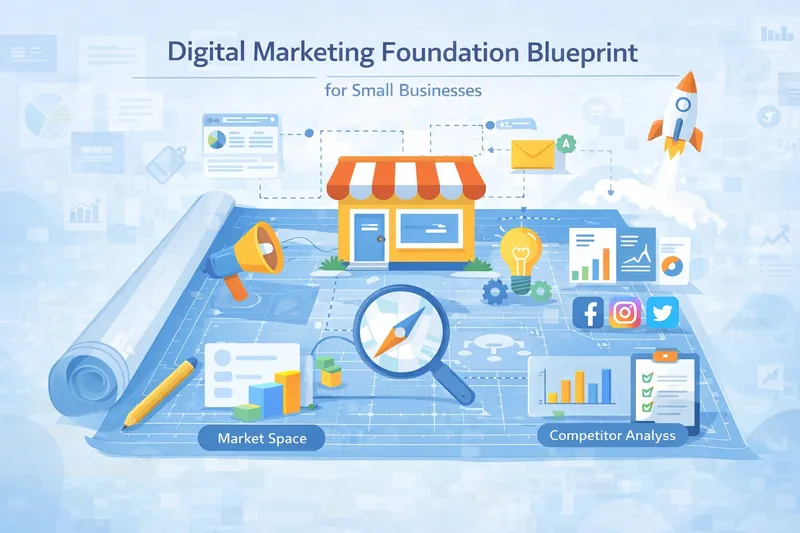
Introduction - Digital Marketing Foundation Blueprint
Ravi opened his small design studio with big dreams and a modest budget. He built a website. He created social media pages. He even ran a few ads.
But nothing moved.
No steady leads. No clear strategy. Just random efforts.
If this sounds familiar, you are not alone.
Many small businesses start digital marketing without building a strong digital marketing foundation. They post content without a plan. They run ads without knowing their audience. They expect sales without building trust.
Digital marketing is not about being everywhere. It is about building a clear system.
This pillar guide gives you that system.
You will learn:
- What digital marketing really means
- How to create a practical marketing strategy
- How to define your customer persona
- How the sales funnel works
- Organic vs paid marketing differences
- Lead generation methods
- Conversion optimization basics
- Marketing automation setup
- Email marketing Strategy
- Content marketing strategy
- Brand positioning, analytics, and performance tracking
This article acts as your complete digital marketing blueprint. Each section connects to detailed cluster guides that expand every topic step by step.
Let’s begin with the foundation.
What Is Digital Marketing? (The Real Beginner Explanation)
Many people think digital marketing means posting on Instagram or running Google Ads.
That is only a small part of it.
Digital marketing is the structured process of attracting, engaging, converting, and retaining customers using online channels.
It includes:
- Search engines (SEO)
- Social media marketing
- Email marketing
- Content marketing
- Paid advertising
- Affiliate marketing
- Influencer marketing
- Conversion rate optimization
- Marketing automation
- Analytics and tracking
At its core, digital marketing does three things:
- Brings attention
- Builds trust
- Drives action
If your marketing does not move people through these three steps, it will not produce consistent revenue.
The Shift in Customer Behavior
Today’s customers:
- Search on Google before buying
- Read reviews
- Compare competitors
- Check social proof
- Watch videos before making decisions
According to global consumer studies, more than 80% of buyers research online before purchasing — even for local businesses.
This means one thing:
If your business does not have a structured online presence, you are invisible to most potential customers.
That is why building a digital marketing foundation is not optional anymore.
It is the base of modern business growth.
Core Components of a Strong Digital Marketing Foundation
A successful digital marketing foundation is built on interconnected systems that work together to drive consistent growth. From defining your:
- Customer persona
- Crafting a digital marketing strategy
- Building sales funnels
- Generating leads
- Optimizing conversions
- Setting up automation
- Content marketing
- Email marketing systems
- Brand positioning
- Data-driven analytics
When combined all these marketing strategies together, these elements create a scalable framework that turns traffic into revenue and strategy into measurable business performance.
How to Create a Digital Marketing Strategy
A practical marketing strategy connects your business goals to measurable actions. It defines your target audience, value proposition, content direction, and conversion path. Without strategy, marketing becomes random activity instead of structured growth.
A clear roadmap helps you allocate budget, choose channels, and prioritize execution. It also ensures every campaign aligns with long-term business objectives. Strong strategy is the backbone of a sustainable digital marketing foundation.
👉 Read more here: Digital Marketing Strategy
How to Define Your Customer Persona
Customer personas help you understand who you are targeting and why they buy. They go beyond demographics and focus on pain points, motivations, and behaviors.
A well-defined persona improves messaging clarity and content relevance. It reduces wasted ad spend by narrowing your targeting. When you understand your audience deeply, conversions increase naturally. Persona clarity turns marketing into precise communication instead of guesswork.
👉 Read more here: How to Define Customer Persona for Marketing
How the Sales Funnel Works
A sales funnel maps the journey from awareness to purchase. It structures how strangers become leads and leads become customers. Each stage requires different messaging and content formats.
Funnels prevent traffic from leaving without engagement. When optimized, they create predictable revenue systems. A strong funnel transforms marketing into a scalable growth engine.
👉 Read more here: How the Sales Funnel Works in Digital Marketing
Organic vs Paid Marketing Differences
Organic marketing builds long-term authority through content and SEO. Paid marketing delivers faster results through targeted advertising. Organic channels grow steadily but require patience and consistency.
Paid campaigns generate immediate visibility but depend on budget. The smartest approach combines both for stability and scale. Balancing short-term wins with long-term growth is key.
👉 Read more here: Organic vs Paid Marketing Key Differences
Lead Generation Methods
Lead generation turns website visitors into potential customers. It typically involves lead magnets, landing pages, and opt-in forms. Value exchange is the core principle behind successful lead capture.
Effective systems nurture prospects before pitching offers. Without lead generation, traffic has no long-term business value. A structured approach increases qualified prospects consistently.
👉 Read more here: Lead Generation Methods for Digital Growth
Conversion Optimization Basics
Conversion optimization improves the percentage of visitors who take action. Small design and messaging changes can significantly increase revenue. Clear headlines, strong calls-to-action, and social proof matter most.
User experience and page speed directly affect results. Data-driven testing eliminates assumptions. Optimization ensures your traffic efforts do not go to waste.
👉 Read more here: Conversion Optimization Basics for Higher ROI
Marketing Automation Setup
Marketing automation streamlines repetitive tasks and follow-ups. It ensures leads receive timely communication without manual effort.
Automation improves consistency across the customer journey. It connects funnels, email sequences, and CRM systems. Proper setup increases efficiency and reduces human error. Automation turns marketing into a scalable system.
👉 Read more here: Marketing Automation Setup for Business Growth
Email Marketing Foundation
Email marketing builds direct communication with your audience. Unlike social media, you own your subscriber list. It enables personalized messaging and automated nurturing.
Email campaigns often deliver high return on investment. Consistent engagement builds trust over time. A strong foundation supports long-term customer relationships.
👉 Read more here: Email Marketing Strategy – Generate Business Leads Effectively
Content Marketing Strategy
Content marketing attracts, educates, and nurtures your audience. It supports SEO, builds authority, and drives organic traffic. Strategic content aligns with each stage of the funnel.
Consistency and relevance determine long-term success. High-quality content builds brand credibility. A structured plan transforms content into business growth.
👉 Read more here: content-marketing-strategy
Digital Marketing Analytics
Analytics measures performance and guides decision-making. Tracking metrics reveals what works and what needs improvement. Key indicators include traffic sources, conversion rates, and ROI.
Data eliminates guesswork in marketing investments. Performance monitoring supports continuous optimization. Strong analytics keeps your strategy aligned with growth goals.
👉 Read more here: Digital Marketing Analytics for Data-Driven Growth
Brand Positioning, Analytics, and Performance Tracking
Brand positioning defines how your business stands out in the market. Differentiation builds trust and emotional connection. Clear positioning improves messaging consistency.
Analytics validates whether your positioning resonates with audiences. Performance tracking ensures long-term brand relevance. Strategic alignment between brand and data drives sustainable growth.
👉 Read more here: Brand Positioning Strategy for Competitive Advantage
Conclusion: Build Once, Improve Forever
Digital marketing is not about random posting.
It is not about chasing trends.
It is about building a structured system.
Let’s recap your complete digital marketing blueprint:
- Understand what digital marketing truly means
- Create a clear strategy
- Define your customer persona
- Build a sales funnel
- Balance organic and paid marketing
- Implement strong lead generation
- Improve conversion rates
- Set up marketing automation
- Build a powerful email system
- Create consistent content marketing
- Track performance using analytics
- Define strong brand positioning
When these pillars work together, marketing becomes predictable.
Ravi did not become successful overnight.
But once he built his digital marketing foundation, growth stopped feeling random.
It became systematic.
And that is what separates struggling startups from scalable businesses.
References & Further Reading
The following trusted resources provide deeper insights into digital marketing strategy, customer behavior, content marketing, analytics, and performance optimization. These references support the concepts discussed in the Digital Marketing Foundation blueprint and offer practical data, research, and expert guidance for small businesses and startups.
- Think with Google – Consumer Insights — Research-backed insights on online buyer behavior, search trends, and decision-making patterns.
- HubSpot Marketing Blog — In-depth guides on inbound marketing, sales funnels, CRM systems, and automation best practices.
- Mailchimp Email Marketing Benchmarks — Industry data on email open rates, click-through rates, and campaign performance benchmarks.
- Google SEO Starter Guide — Official guidance from Google on search engine optimization fundamentals and website best practices.
- Conversion Rate Optimization Guide – Neil Patel — Practical strategies for improving landing pages, CTAs, and overall website conversions.
- Content Marketing Institute – What Is Content Marketing? — Foundational explanations and frameworks for building long-term content strategies.
- Statista – Social Media Statistics — Updated statistics and data trends on social media usage and digital adoption globally.
- Forbes Agency Council – Marketing Insights — Expert commentary and strategic advice from marketing leaders and industry professionals.
Frequently Asked Questions
What is a digital marketing foundation and why is it important for small businesses?
A digital marketing foundation is the structured system that connects strategy, audience targeting, content, funnel, lead generation, conversion optimization, automation, and analytics. For small businesses, it prevents random marketing actions and wasted budgets. Instead of posting without direction, you build a predictable system that attracts, nurtures, and converts customers consistently.
How long does it take to see results from digital marketing?
The timeline depends on your strategy and channels. Paid ads can generate leads within days if your funnel is ready. However, organic marketing like SEO and content marketing usually takes three to six months to show strong results. A balanced digital marketing foundation combines both short-term and long-term approaches for steady growth.
Should a startup focus on organic marketing or paid advertising first?
Startups with limited budgets should build strong organic assets such as SEO content and email lists first. If the offer is validated and the funnel converts well, paid ads can accelerate growth. The best approach is a hybrid model where organic builds stability and paid campaigns scale what already works.
What is the role of a sales funnel in digital marketing?
A sales funnel guides potential customers through awareness, consideration, and decision stages. Without a funnel, traffic comes and leaves without converting. With a structured funnel, you educate prospects, build trust, and present offers at the right time. This makes your marketing predictable and improves conversion rates.
How do I create an effective customer persona?
Start by analyzing your existing customers and market data. Identify demographics, pain points, goals, buying behavior, and preferred online platforms. Use surveys, analytics tools, and sales conversations for insights. A clear persona helps you create focused content, targeted ads, and relevant messaging that improves engagement and conversions.
Why is email marketing still important in modern digital marketing?
Email marketing remains powerful because you own your subscriber list. Unlike social media, you are not dependent on algorithms. Email allows direct communication, personalized messaging, automated follow-ups, and consistent nurturing. It often delivers higher return on investment compared to many other digital channels.
What are the most effective lead generation methods for small businesses?
Effective methods include lead magnets like checklists or ebooks, focused landing pages, webinars, free consultations, referral programs, and optimized opt-in forms. The key is offering real value in exchange for contact details and following up with structured email sequences to move leads through your funnel.
How can I improve my website conversion rate?
Improve conversions by using clear headlines, strong calls-to-action, social proof, fast loading speed, mobile optimization, and simplified forms. A/B testing different headlines and page layouts can reveal what works best. Even small changes in messaging or design can significantly increase your overall revenue.
What metrics should I track to measure digital marketing success?
Track traffic sources, conversion rates, cost per lead, customer acquisition cost, return on ad spend, email open rates, and customer lifetime value. These metrics show whether your strategy is profitable. Data-driven decisions help you refine campaigns and strengthen your digital marketing foundation over time.
Can a small business manage digital marketing without hiring an agency?
Yes, many small businesses start independently by learning core concepts like strategy, funnel building, content creation, and analytics tracking. However, as growth increases, outsourcing specialized tasks such as SEO or paid ads can save time and improve results. The key is building a solid foundation first before scaling efforts.



Comments Section