

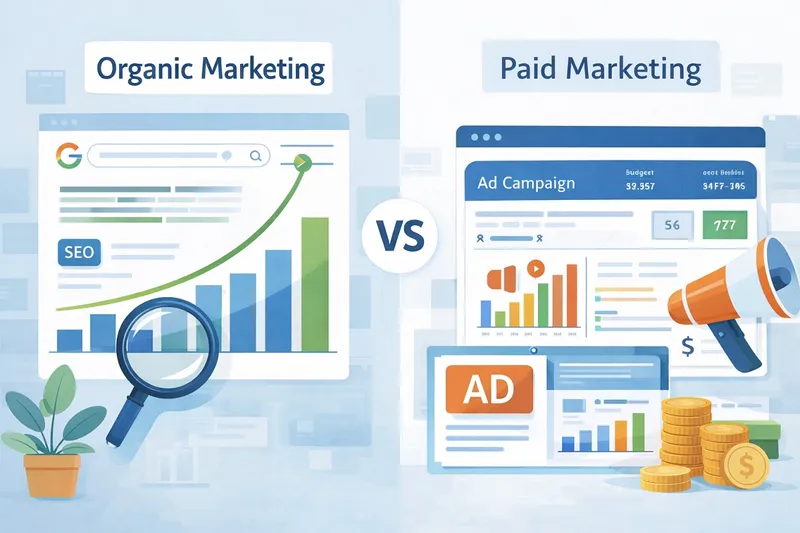
Introduction - Organic vs Paid Marketing
Understanding organic vs paid marketing is essential for building a balanced growth strategy. Both approaches attract customers, but they differ in cost structure, timeline, scalability, and long-term impact.
Organic marketing focuses on content, search visibility, and audience trust built over time. Paid marketing relies on advertising budgets to generate immediate traffic and measurable results.
Organic vs Paid Marketing: What Should Small Businesses Choose?
Ravi once spent his entire monthly marketing budget on ads.
He saw traffic for 10 days.
Then it stopped.
No ads. No traffic.
That is when he realized something important.
Paid marketing gives speed.
Organic marketing gives stability.
A strong digital marketing foundation usually includes both — but in the right balance.
What Is Organic Marketing?
Organic marketing means attracting traffic without directly paying for clicks.
Examples:
- Search engine optimization (SEO)
- Blog content
- Social media posts
- YouTube videos
- Email marketing
- Community building
- Referral programs
You invest time and effort instead of ad budget.
The benefit?
Long-term visibility.
For example, a well-written SEO blog post can generate traffic for years.
What Is Paid Marketing?
Paid marketing means you pay platforms to show your content or ads.
Examples:
- Google Ads
- Facebook Ads
- Instagram Ads
- LinkedIn Ads
- YouTube Ads
- Sponsored posts
Paid marketing brings immediate traffic.
But once you stop paying, traffic stops.
Key Differences Between Organic and Paid Marketing
Here is a simple comparison:
Organic Marketing
- Takes time to show results
- Builds long-term trust
- Lower cost over time
- Compounds gradually
Paid Marketing
- Fast results
- Scalable quickly
- Requires consistent budget
- Good for testing offers
When Should You Focus on Organic?
Focus more on organic marketing if:
- You have limited budget
- You want sustainable traffic
- You are building authority
- You sell high-trust services (consulting, coaching, B2B)
SEO and content marketing become your strongest assets here.
For startups, organic marketing often forms the backbone of a digital marketing foundation.
When Should You Focus on Paid?
Paid marketing works best when:
- You need quick leads
- You have a validated offer
- You want to scale
- You have clear funnel and landing pages
- You can track return on ad spend
Running ads without a sales funnel or landing page is risky.
Always test small before scaling.
The Smart Approach: Hybrid Model
Most successful small businesses use a hybrid model.
For example:
- SEO blog posts bring steady traffic
- Email list nurtures leads
- Paid ads promote high-converting offers
- Retargeting ads bring back visitors
This creates stability + speed.
Real Example: Service-Based Startup
Let’s say you run a digital marketing agency.
Your balanced plan could be:
- Weekly SEO blog posts (organic growth)
- LinkedIn thought leadership posts
- Free strategy call lead magnet
- Google Ads targeting “hire digital marketing agency”
- Retargeting ads for website visitors
This way, you do not depend only on ads or only on SEO.
You build both authority and lead flow.
Important: Track ROI
No matter what you choose, measure:
- Cost per lead
- Customer acquisition cost
- Lifetime value
- Return on ad spend
- Conversion rate
If organic content brings leads at lower cost, double down.
If paid ads convert well, scale carefully.
Data decides.
Organic and paid marketing are tools.
Strategy decides how to use them.
Cost Structure and ROI Comparison
One major difference in organic vs paid marketing is financial structure.
Organic marketing:
- Lower direct costs
- Requires time investment
- Compounds value over time
- Slower initial traction
Paid marketing:
- Requires ongoing ad spend
- Faster traffic generation
- Easier performance tracking
- Stops when budget stops
A strategic combination often produces the most stable results.
When to Use Paid and Organic Advertising Approaches
Use organic marketing when:
- Building brand authority
- Investing in long-term SEO
- Creating educational content
- Growing email lists gradually
Use paid marketing when:
- Launching new products
- Testing offers
- Scaling validated funnels
- Generating short-term leads
Balancing both reduces dependency on a single traffic source.
Conclusion
A strong growth system does not rely solely on organic vs paid marketing. Instead, it integrates both approaches strategically. Organic builds stability and long-term equity, while paid campaigns accelerate acquisition. Businesses that balance these channels create consistent and measurable performance.
References & Further Reading
The following resources provide data-backed insights on organic growth strategies, paid advertising performance, and channel allocation decisions.
- Think with Google – Search & Advertising Insights — Research on paid search performance and audience behavior trends.
- Moz – Beginner’s Guide to SEO — Comprehensive overview of organic search optimization fundamentals.
- HubSpot – Paid vs Organic Marketing — Comparative insights on traffic acquisition and growth strategy.
Frequently Asked Questions
What is the difference between organic vs paid marketing?
Organic marketing focuses on unpaid strategies like SEO and content creation, while paid marketing relies on advertising budgets to generate immediate traffic and leads.
Which is better, organic or paid marketing?
Neither is universally better. Organic marketing builds long-term authority, while paid marketing delivers faster results. A balanced strategy often performs best.
Does organic marketing cost money?
Organic marketing does not require direct ad spend, but it requires time, content production, and optimization efforts to build visibility and trust.
How quickly does paid marketing show results?
Paid marketing can generate traffic and leads within days if targeting, funnel structure, and messaging are properly optimized.
Is organic marketing more sustainable?
Organic marketing often provides long-term traffic stability because content continues attracting visitors even after initial publication.
Can small businesses rely only on organic marketing?
Small businesses can start with organic marketing, but combining it with selective paid campaigns can accelerate growth once systems are validated.
What metrics should be tracked for paid marketing?
How does SEO fit into organic marketing?
SEO improves search engine visibility, helping businesses attract consistent traffic without ongoing advertising payments.
Does paid marketing affect SEO rankings?
Paid ads do not directly impact organic rankings, but increased visibility can improve brand recognition and user engagement.
How should businesses allocate budget between organic and paid channels?
Budget allocation depends on growth stage, goals, and resources, but a diversified approach reduces risk and improves overall performance.



Comments Section