

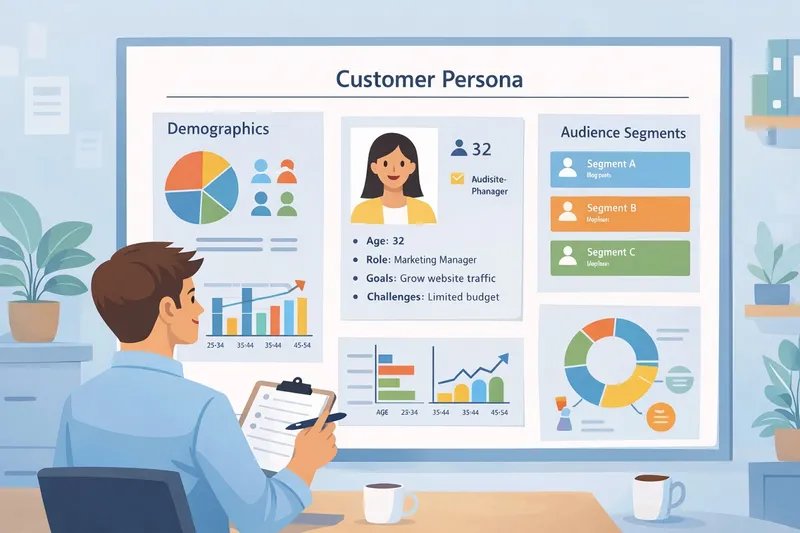
Introduction to Customer Research & Buyer Persona
To define customer persona accurately, you need more than assumptions about age or income. A customer persona represents a research-based profile of your ideal buyer, including motivations, challenges, buying behavior, and decision triggers.
When businesses define customer persona clearly, marketing becomes focused, messaging improves, and conversion rates increase. This process turns general targeting into strategic communication aligned with real customer needs.
Customer Persona Creation Guide (Foundation Level)
When Ravi stopped marketing to “everyone,” something changed.
He stopped writing generic posts.
He stopped running broad ads.
He started speaking directly to one type of person.
Leads increased.
Why?
Because clarity attracts.
A strong digital marketing foundation always rests on one thing: knowing exactly who you serve.
What Is a Customer Persona?
A customer persona is a detailed profile of your ideal customer.
It is not guesswork.
It is based on:
- Real data
- Customer interviews
- Market research
- Sales conversations
- Analytics
Think of it as creating a real human profile for your marketing.
Instead of saying:
“We target small businesses.”
Say:
“We help 28–40 year old startup founders who struggle with branding and want investor-ready websites.”
See the difference?
Specific wins.
Why Most Small Businesses Fail Here
Many businesses skip persona creation because they think:
“My product is for everyone.”
But when you speak to everyone, no one feels understood.
Modern buyers want:
- Relevance
- Personalization
- Clarity
That is why targeted marketing converts better than broad messaging.
How to Create a Powerful Customer Persona
Let’s break it into simple steps.
Start with Demographics
Basic information:
- Age range
- Gender (if relevant)
- Location
- Income level
- Profession
- Education
This gives you structure.
Understand Their Problems (This Is Critical)
Ask:
- What keeps them awake at night?
- What problem are they actively trying to solve?
- What frustrates them about competitors?
- What outcome do they want?
Example:
A startup founder might struggle with:
- Low website conversions
- Poor brand identity
- No clear marketing direction
Your marketing must speak directly to these pain points.
Study Their Online Behavior
Ask:
- Which platforms do they use?
- Do they search on Google often?
- Do they watch YouTube tutorials?
- Do they trust email newsletters?
If your audience spends time on LinkedIn, Instagram might not give you results.
Channel choice depends on persona.
Identify Buying Triggers
What makes them take action?
- Discounts?
- Limited-time offers?
- Social proof?
- Case studies?
- Free consultation?
This directly connects to conversion optimization and sales funnel design, which we will cover next.
Real-Life Example: Fitness Coach
Let’s say you are a fitness coach.
Instead of targeting “people who want fitness,” create this persona:
- Name: Working Professional Arjun
- Age: 32
- Location: Metro city
- Problem: No time to visit gym
- Goal: Lose 8 kg in 4 months
- Behavior: Watches fitness reels at night
- Concern: Worried about sustainability
Now your marketing becomes:
- Instagram reels at 9 PM
- “Lose weight without gym” blog posts
- 20-minute home workout plan lead magnet
- Email sequence with weekly meal plans
Everything becomes aligned.
Data Sources for Persona Creation
Use:
- Google Analytics audience data
- Social media insights
- Customer surveys
- Competitor reviews
- Sales call notes
Do not assume. Validate.
Connect Persona to Strategy
Your:
- Content marketing strategy
- Ad targeting
- Email messaging
- Sales funnel
- Lead magnets
All depend on persona clarity.
Without it, your digital marketing foundation will crack.
With it, every marketing action becomes focused.
Data Sources for Persona Accuracy
Many businesses rely on guesswork instead of verified data. To strengthen credibility and results, combine:
- CRM insights
- Website analytics
- Sales call transcripts
- Customer surveys
- Social listening insights
- Competitor positioning analysis
Using multiple data sources increases reliability and supports an E-E-A-T aligned approach built on experience and evidence.
Conclusion
When you define customer persona using structured research, your marketing becomes measurable and efficient. Strong personas influence content creation, funnel structure, ad targeting, and brand positioning. Businesses that rely on verified audience insights consistently outperform competitors relying on broad targeting methods.
References & Further Reading
The following resources provide research-backed guidance on customer persona development, audience segmentation, and behavioral targeting strategies.
- HubSpot – Buyer Persona Research Guide — Step-by-step guidance for creating data-driven customer personas.
- Think with Google – Consumer Insights — Research on buyer behavior and decision-making patterns.
- Semrush – Target Audience Analysis — Practical methods for audience segmentation and behavioral research.
Frequently Asked Questions
What is a customer persona in marketing?
A customer persona is a research-based representation of your ideal buyer that includes demographics, behavior patterns, goals, challenges, and buying motivations used to guide marketing strategy.
Why is it important to define customer persona?
When businesses define customer persona accurately, they improve targeting precision, messaging clarity, content relevance, and overall conversion performance.
How many customer personas should a business create?
Most businesses benefit from creating two to four core personas representing primary audience segments instead of trying to target everyone broadly.
What data should be used to build a persona?
Effective personas are built using analytics data, CRM insights, surveys, customer interviews, and sales feedback rather than assumptions.
Can small businesses benefit from customer personas?
Yes, small businesses gain major efficiency improvements when they define customer persona clearly because it reduces wasted advertising budget and improves engagement.
How often should customer personas be updated?
Personas should be reviewed annually or whenever significant market, product, or customer behavior changes occur.
What is the difference between target audience and persona?
A target audience is a broad group, while a persona is a detailed profile representing a specific segment within that audience.
Do customer personas improve SEO performance?
Yes, understanding audience intent helps create relevant content that aligns with search queries and improves organic visibility.
What mistakes should be avoided when defining personas?
Avoid relying on stereotypes, ignoring data, or creating too many personas that complicate strategy execution.
How does persona research impact paid advertising?
Clear persona data improves ad targeting accuracy, reduces cost per acquisition, and increases campaign effectiveness.



Comments Section