
Introduction to Sales Funnel in Digital Marketing
Understanding how the sales funnel works is essential for turning website visitors into paying customers. A sales funnel structures the customer journey into stages, guiding prospects from first interaction to final purchase.
Without a defined funnel, traffic often leaves without taking action. When structured correctly, each stage supports awareness, engagement, decision-making, and long-term retention.
Sales Funnel Explained for Beginners
Ravi once believed that people visited his website and either bought or left.
That belief cost him months of confusion.
In reality, customers rarely buy on the first interaction.
They move through stages.
This movement is called a sales funnel.
Understanding this concept changes everything.
What Is a Sales Funnel?
A sales funnel is the step-by-step journey a potential customer takes before becoming a paying client.
It usually has three core stages:
- Awareness
- Consideration
- Decision
Some marketers break it into five stages, but for small businesses, these three are enough to build a strong digital marketing foundation.
Stage 1: Awareness (Top of Funnel – TOFU)
At this stage, the customer realizes they have a problem.
They are not looking for your product yet.
They are searching for information.
Examples:
- “Why is my website not getting traffic?”
- “How to lose weight at home?”
- “Best accounting software for small business”
Your goal here is simple:
Educate. Not sell.
Best channels:
- Blog posts
- YouTube videos
- Social media content
- SEO content marketing
If you push sales here, people leave.
Instead, build trust.
Stage 2: Consideration (Middle of Funnel – MOFU)
Now the customer understands their problem.
They are comparing solutions.
They search things like:
- “Best web design agency for startups”
- “Email marketing software comparison”
- “Online fitness coach reviews”
Your goal here:
Build authority.
Use:
- Case studies
- Testimonials
- Webinars
- Comparison guides
- Email nurturing sequences
This is where many small businesses fail.
They attract attention but never nurture interest.
Stage 3: Decision (Bottom of Funnel – BOFU)
At this stage, the customer is ready.
They search:
- “Hire web design agency Chennai”
- “Buy keto diet plan”
- “Sign up for CRM software”
Now you present:
- Clear offer
- Strong CTA
- Simple checkout
- Limited-time bonus
- Free consultation
Remove friction.
Make buying easy.
Why Most Funnels Fail
Small businesses often:
- Drive traffic but collect no leads
- Run ads without landing pages
- Ignore email follow-ups
- Fail to retarget visitors
That means they lose warm prospects.
A proper funnel includes:
- Traffic source
- Lead magnet
- Landing page
- Email sequence
- Sales offer
- Follow-up
This connects directly with:
- Lead generation methods
- Email marketing setup
- Conversion optimization
- Marketing automation
Everything links together.
Simple Funnel Example: Online Course
Let’s say you sell a digital marketing course.
Your funnel could look like this:
- Blog post: “What is digital marketing?”
- Free checklist download
- Email sequence explaining basics
- Webinar invite
- Limited-time course discount
- Follow-up reminder
Now marketing becomes predictable.
Traffic flows into a system.
Leads move step by step.
Sales increase steadily.
Funnel + Persona + Strategy = Strong Foundation
Notice how everything connects:
- Strategy defines goals
- Persona defines audience
- Funnel defines journey
This structure builds a stable digital marketing foundation.
Without a funnel, marketing feels random.
With a funnel, marketing feels organized.
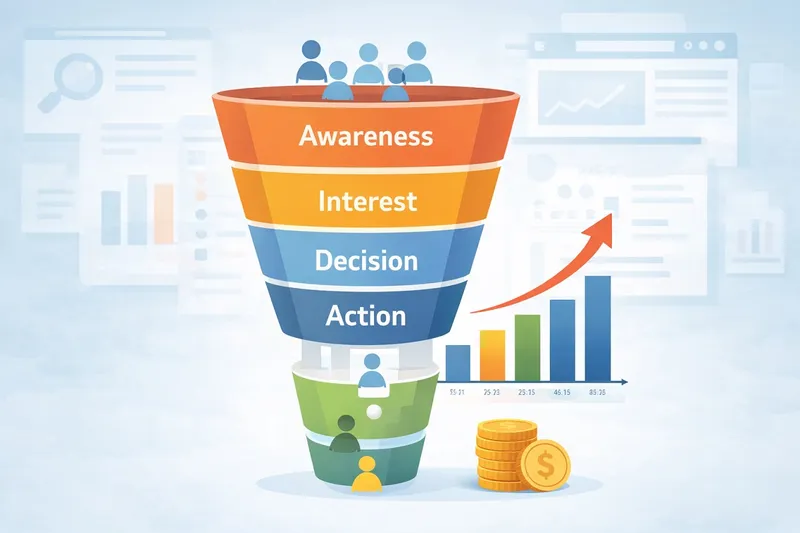
Core Stages of a High-Performing Funnel
While funnels vary by industry, most include:
- Awareness (educational content, SEO, ads)
- Interest (lead magnets, landing pages)
- Consideration (email nurturing, case studies)
- Conversion (offers, sales pages)
- Retention (follow-up, upsell, loyalty systems)
Each stage must align with user intent. Mismatched messaging reduces trust and weakens performance.
Common Funnel Mistakes to Avoid
Even when businesses understand how the sales funnel works, execution errors reduce results:
- Sending traffic directly to a sales page without nurturing
- Lack of clear call-to-action
- No follow-up system
- Ignoring data and conversion tracking
- Overcomplicating funnel stages
Simplicity and clarity often outperform complex systems.
Conclusion
When you understand how the sales funnel works and implement it strategically, marketing becomes predictable rather than random. Funnels create clarity in messaging, guide user behavior, and support scalable growth. Businesses that optimize each stage consistently generate stronger long-term results.
References & Further Reading
The following resources provide structured guidance on sales funnel design, lead nurturing systems, and conversion-focused marketing frameworks.
- HubSpot – Sales Funnel Guide — Overview of funnel stages and how they impact revenue generation.
- Shopify – Sales Funnel Explained — Practical explanation of funnel stages and customer journey mapping.
- Neil Patel – Conversion Funnel Guide — Insights on optimizing funnel stages for improved conversion rates.
Frequently Asked Questions
What is a sales funnel in digital marketing?
A sales funnel is a structured process that guides potential customers through awareness, interest, consideration, and conversion stages to turn traffic into paying clients.
Why is understanding how the sales funnel works important?
Understanding how the sales funnel works helps businesses structure marketing efforts properly, reduce wasted traffic, and improve lead nurturing efficiency.
How many stages are typically in a sales funnel?
Most funnels include awareness, interest, consideration, conversion, and retention stages, though the exact structure may vary depending on the business model.
What happens if a business does not use a sales funnel?
Without a funnel, website visitors may leave without taking action, resulting in low conversion rates and inconsistent revenue growth.
How does content fit into a sales funnel?
Content supports each stage by educating prospects at the top, building trust in the middle, and encouraging action at the bottom of the funnel.
Can small businesses benefit from a sales funnel?
Yes, even simple funnels improve lead tracking, messaging consistency, and overall marketing performance for small businesses.
How do you measure sales funnel performance?
Track metrics such as conversion rate per stage, cost per lead, customer acquisition cost, and overall revenue generated.
What tools are used to build a sales funnel?
Businesses often use landing page builders, CRM systems, email automation platforms, and analytics tools to manage funnel stages.
Is a sales funnel only for online businesses?
No, both online and offline businesses use funnel principles to guide prospects from awareness to purchase decisions.



Comments Section