

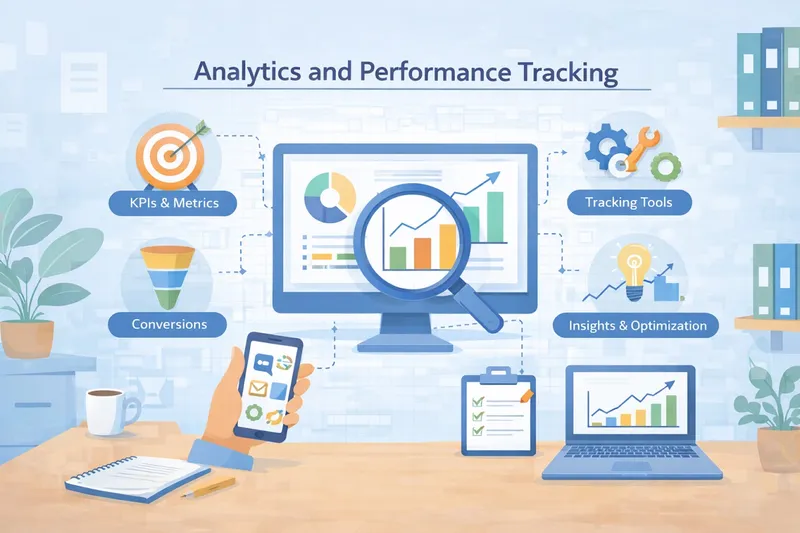
Introduction - Digital Marketing Analytics
Digital marketing analytics allows businesses to measure campaign performance, track customer behavior, and evaluate return on investment with precision. Instead of relying on assumptions, analytics provides measurable data that guides strategic improvements.
A structured digital marketing analytics system connects traffic sources, conversion metrics, and customer journeys into one clear performance framework.
Analytics, Tracking & Performance Measurement: Turning Data Into Smart Decisions
Ravi once believed more traffic meant success.
Then he checked deeper numbers.
Most visitors left within 10 seconds.
Traffic was not the problem.
Relevance was.
That insight came from analytics.
Without tracking performance, marketing becomes guesswork.
With data, marketing becomes strategic.
Why Analytics Matters for Small Businesses
Analytics helps you:
- Identify what works
- Eliminate what fails
- Improve conversion rates
- Reduce marketing waste
- Increase return on investment
It strengthens your digital marketing foundation because every decision becomes evidence-based.
Essential Metrics You Must Track
Let’s break this into practical categories.
Traffic Metrics
Track:
- Total website visitors
- Traffic sources (organic, paid, social, email)
- New vs returning users
- Top-performing pages
If organic traffic grows steadily, your content marketing works.
If paid traffic converts poorly, optimize landing pages.
Engagement Metrics
Track:
- Time on page
- Bounce rate
- Scroll depth
- Pages per session
High bounce rate may indicate:
- Weak headline
- Slow loading speed
- Poor content match
- Confusing layout
Engagement shows how interested users are.
Conversion Metrics
This is where revenue hides.
Track:
- Conversion rate
- Cost per lead
- Cost per acquisition
- Return on ad spend
- Email signup rate
Even a small improvement in conversion rate increases profit significantly.
Email Performance Metrics
Monitor:
- Open rate
- Click-through rate
- Unsubscribe rate
- Revenue per email
If open rate is low, improve subject lines.
If click rate is low, improve messaging clarity.
Customer Value Metrics
Track long-term numbers:
- Customer lifetime value
- Repeat purchase rate
- Average order value
These metrics show business health, not just marketing performance.
Analytics & Performance Tools to Use
Most small businesses can start with:
- Google Analytics
- Google Search Console
- Meta Ads dashboard
- Email marketing reports
- CRM reporting
You do not need complex enterprise tools initially.
Start simple.
Example: Data-Driven Improvement
Ravi noticed:
Blog post traffic: High Email signups: Low
He added:
- Content upgrade
- Better CTA placement
- Stronger headline
Signup rate increased from 0.8% to 2.5%.
Same traffic. Better results.
That is data working for you.
Set Monthly Review Habit
Every month:
- Review top traffic sources
- Identify high-converting pages
- Pause underperforming ads
- Improve top-performing content
- Test new headlines or CTAs
Consistency builds growth.
Analytics + Strategy = Predictable Growth
Data connects all pillars:
- Strategy
- Persona
- Funnel
- Content
- Paid ads
- Email marketing
- Automation
Without measurement, your digital marketing foundation remains weak.
With measurement, it becomes stronger every month.
Core Metrics Every Business Should Track
An effective digital marketing analytics system focuses on:
- Website traffic sources
- Conversion rates
- Cost per acquisition (CPA)
- Customer lifetime value (CLV)
- Bounce rate and engagement metrics
- Funnel drop-off points
Tracking these indicators helps identify strengths and performance gaps.
Tools That Support Analytics Implementation
To build a strong digital marketing analytics setup, businesses commonly use:
- Web analytics platforms
- CRM reporting dashboards
- Email campaign analytics
- Paid advertising dashboards
- Heatmap and behavior tracking tools
Combining multiple data sources ensures accurate insights across channels.
Conclusion
Data-driven marketing is no longer optional. A well-structured digital marketing analytics system enables continuous improvement, smarter budget allocation, and measurable business growth.
References & Further Reading
The following resources provide in-depth insights into marketing measurement, performance tracking, and analytics frameworks.
- Google Analytics – Official Platform — Web analytics platform for tracking traffic and user behavior.
- HubSpot – Marketing Analytics Guide — Strategy and reporting best practices.
- Think with Google – Marketing Insights — Data-driven marketing research and case studies.
Frequently Asked Questions
What is digital marketing analytics?
It is the process of collecting and analyzing marketing data to measure campaign performance and improve decision-making.
Why is marketing analytics important?
It helps businesses track ROI, identify successful channels, and optimize campaigns based on measurable insights.
What tools are used for digital marketing analytics?
Businesses use web analytics platforms, CRM systems, ad dashboards, and email reporting tools to gather performance data.
What is a conversion rate?
Conversion rate measures the percentage of users who complete a desired action, such as a purchase or form submission.
How often should analytics be reviewed?
Performance data should be reviewed weekly or monthly depending on campaign scale and budget.
What is cost per acquisition?
CPA calculates how much it costs to acquire one paying customer through marketing efforts.
Can small businesses benefit from analytics?
Yes, even basic analytics tracking improves budget allocation and campaign efficiency.
What is customer lifetime value?
CLV estimates the total revenue a customer generates throughout their relationship with a business.
How does analytics improve lead generation?
What is funnel analysis?
Funnel analysis examines where users drop off during the buying journey to improve conversion performance.



Comments Section