

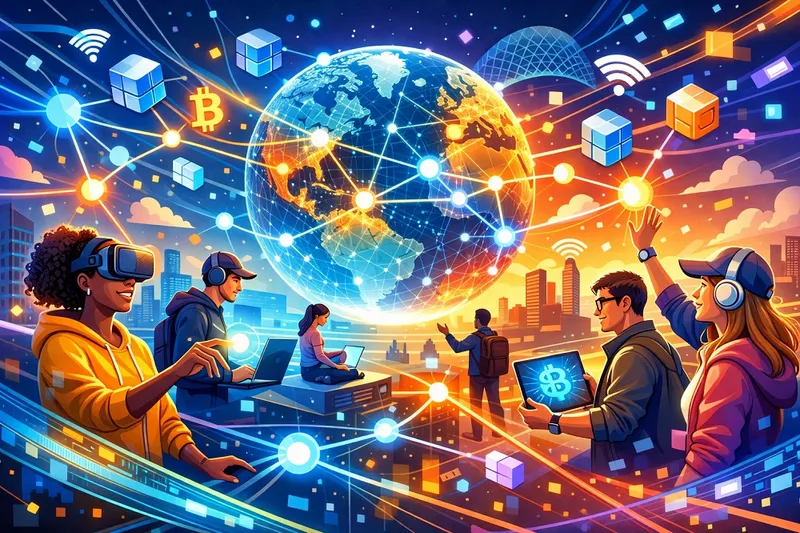
Introduction: A Small Story About a Big Internet Problem
Imagine waking up one day and finding your favorite app gone. Your photos, messages, and contacts vanish. Not because you did something wrong, but because one company decided to shut down a service.
This has happened many times. Social networks close accounts. Payment apps block users. Websites disappear overnight. These moments show a quiet truth about today’s internet: most of it runs on central control.
That is where decentralization comes in.
Decentralization is not just a tech idea. It is a response to real problems people face online every day. It asks a simple question: should the internet belong to a few companies, or to everyone who uses it?
Let’s understand this idea step by step, in simple words, through real stories, clear examples, and practical meaning.
What Is Decentralization in Simple Terms?
Decentralization means spreading control instead of keeping it in one place.
In a centralized system:
- One company owns the servers
- One authority makes the rules
- Users depend on that single point
In a decentralized system:
- Data lives across many computers
- No single owner controls everything
- Users share power and responsibility
Think of it like this.
A bank is centralized. It holds your money and decides how you can use it.
Cash is decentralized. You hold it. You spend it. No one can freeze it with a click.
The internet started as a decentralized idea. Over time, it became more centralized. Now, many people want to bring balance back.
How the Internet Became Centralized Over Time
In the early days, the internet felt open. Anyone could create a website. Email worked between providers. No single company owned everything.
Then things changed.
Big platforms grew fast because they were:
- Easy to use
- Free at the start
- Good at connecting people
Over time, a few companies began to control:
- Social media
- Search
- Online ads
- Cloud storage
According to data from 2024:
- Over 70% of global social traffic flows through just a few platforms
- Over 60% of widely visited websites are managed by just three major cloud service providers.
This concentration created comfort, but also risk.
Why Centralized Systems Create Real Problems
Centralization is not evil by default. It brings speed and simplicity. But it also creates issues that affect everyday users.
Single Point of Failure
Centralized systems rely heavily on a single control point, making them extremely vulnerable when something goes wrong. A single server failure can ripple across platforms, instantly disrupting communication, commerce, and daily operations for millions of users.
This structural weakness highlights why resilience and redundancy are critical in today’s always-connected digital economy. If one server goes down, millions feel the impact.
Examples include:
- Major social networks going offline for hours
- Cloud outages stopping businesses worldwide
Data Control and Privacy
When user data is stored in centralized systems, control shifts away from individuals and into the hands of a few entities. This concentration turns databases into high-value targets for cyberattacks while enabling surveillance, profiling, and unauthorized data monetization.
The scale of recent data breaches exposes how fragile centralized data ownership truly is in the modern internet. When data sits in one place:
- It becomes a target for hacks
- It can be tracked, sold, or misused
In 2023 alone, over 8 billion records were exposed through data leaks. Most came from centralized databases.
Censorship and Control
Centralized platforms hold the power to decide what stays visible and who gets access, shaping online narratives in real time. While moderation can protect users, unchecked authority also allows sudden rule changes and content removal that can suppress legitimate voices.
This balance between safety and freedom remains one of the internet’s most debated challenges. Central authorities can:
- Remove content
- Block users
- Change rules without notice
Sometimes this helps safety. Sometimes it silences voices.
Decentralization Explained Through Everyday Examples
Let’s break this down with simple comparisons.
Email vs Social Media
Email is decentralized.
Email works on open, decentralized protocols that allow anyone to communicate freely, regardless of the service provider they choose.
- You can choose Gmail, Outlook, or your own server
- You can still message anyone
Social media is centralized.
Social media platforms control visibility and access, meaning a single ban can instantly erase years of connections and digital presence.
- One platform controls your reach
- If banned, your network disappears
Torrents vs Direct Downloads
Torrent networks distribute files across many participants, removing dependence on any single server and making the system more resilient.
Torrent networks:
- Share files across many users
- No single server holds everything
Direct downloads rely on a central source, which creates an easy point of failure that can be blocked or taken offline instantly.
Direct downloads:
- Rely on one server
- Easy to shut down
These examples show how decentralization spreads power and risk.
How Decentralization Works Behind the Scenes
Decentralization uses a few core ideas. You do not need to be a tech expert to understand them.
Peer-to-Peer Networks
Peer-to-peer networks remove the need for a central authority by allowing devices to communicate and share resources directly. By spreading responsibility across many participants, the network becomes more resilient, scalable, and resistant to failure or shutdown.
Instead of one main server:
- Computers connect directly
- Each one shares part of the load
This makes networks stronger and harder to break.
Distributed Ledgers
Distributed ledgers store the same record across multiple independent systems, eliminating the need for a single source of truth. By requiring collective agreement for changes, blockchain-based networks create transparency and trust without relying on a central controlling authority.
A distributed ledger keeps records across many systems.
Blockchain is a common example:
- Every participant holds a copy
- Changes need group agreement
This builds trust without one central authority.
Open Rules and Protocols
Open rules and protocols form the foundation of decentralized systems by making the underlying logic transparent to everyone. When anyone can verify, improve, and build on these standards, trust shifts from institutions to openly shared code and community consensus.
Decentralized systems often use open rules:
- Anyone can review them
- Anyone can build on them
This openness builds shared trust.
Why Decentralization Matters in the Modern Internet
Now let’s connect the dots.
More Control for Users
Decentralization shifts power back to users by giving them true ownership of their data and digital identity. With the freedom to choose platforms and move without losing access or connections, individuals are no longer locked into a single service’s ecosystem.
Decentralization gives people:
- Ownership of data
- Choice of platforms
- Freedom to move
You are not trapped inside one service.
Better Privacy
When data is distributed instead of stored in one place, mass breaches become far more difficult to execute. This structure reduces widespread tracking and makes privacy an architectural feature of the system, not just a policy statement.
When data spreads:
- Large data dumps become harder
- Tracking becomes more limited
Privacy becomes a design choice, not a promise.
Stronger Security
Distributed systems reduce risk by eliminating a single point where everything can collapse. When attacks or failures occur, the network can adapt and recover faster, making resilience a built-in advantage rather than an afterthought.
Distributed systems:
- Do not fail all at once
- Recover faster from attacks
This design improves resilience.
Fairer Digital Economy
Decentralized finance and creator platforms reshape the digital economy by removing costly intermediaries and enabling direct value exchange. By allowing users to earn, trade, and transact peer-to-peer, these systems demonstrate how large-scale economic activity can function without traditional gatekeepers.
Decentralized finance and creator platforms:
- Reduce middle layers
- Let users earn directly
In 2024, decentralized finance platforms processed trillions in transactions without banks.
Real-World Use Cases You Already See Today
Decentralization is not a future idea. It already exists.
Cryptocurrencies
Cryptocurrencies like Bitcoin prove that financial systems can operate independently of traditional banks, with transactions governed by transparent code. This decentralization ensures that no single person or organization can dictate or manipulate the network.
Bitcoin showed that:
- Money can move without banks
- Rules can be enforced by code
No single entity controls it.
Decentralized Storage
Decentralized storage spreads data across multiple nodes, making it far less vulnerable to loss or censorship. By ensuring accessibility and security, these platforms empower journalists, researchers, and creators to share and preserve information freely.
Platforms like distributed file systems:
- Store data across many nodes
- Reduce risk of loss
This helps journalists, researchers, and creators.
Open Social Networks
Open social networks let users retain control over their identity and connections while enabling communities to govern themselves. Even if individual servers fail, the network continues to operate, ensuring continuity and resilience for all participants.
New social platforms use open standards:
- Users keep their identity
- Communities set their own rules
If one server shuts down, the network lives on.
Decentralization and Trust: A Quiet Shift
Trust used to rely on brands and logos.
Now trust can rely on:
- Open code
- Shared records
- Community checks
This shift matters because trust shapes how we communicate, trade, and learn online.
A 2024 survey showed:
- 58% of users trust systems more when they can verify data themselves
Decentralization supports this change.
Common Myths About Decentralization
Let’s clear some confusion.
Decentralization Is Too Complex
Many tools now hide technical parts.
- Wallets feel like apps
- Platforms feel familiar
Ease improves each year.
Decentralization Has No Rules
Decentralized systems still follow rules.
- They just enforce them differently
- Communities help guide decisions
Decentralization Replaces Everything
Decentralization does not replace all systems.
- It adds balance
- It offers choice
Hybrid models often work best.
Challenges Decentralization Still Faces
To be honest, decentralization is not perfect.
Some current issues include:
- Slower speed in some networks
- Learning curves for new users
- Legal uncertainty in some regions
These are growing pains, not dead ends.
The Role of Decentralization in the Future Internet
The modern internet is at a crossroads.
People want:
- Freedom without chaos
- Privacy without isolation
- Innovation without control by a few
Decentralization supports these goals by design.
Governments, developers, and users now explore:
- Digital identity owned by users
- Shared networks for public data
- Fair creator economies
The direction is clear, even if the path takes time.
Conclusion: Why This Idea Matters to You
Decentralization is not just for developers or tech fans.
It matters if you:
- Care about your data
- Value free expression
- Want choices online
It reminds us that the internet works best when power spreads, voices matter, and trust grows from openness.
The modern internet does not need one owner. It needs many caretakers. Decentralization invites all of us to be part of that story.
Frequently Asked Questions
What is decentralization in simple words?
Decentralization means spreading control and power across many people or systems instead of keeping everything under one central authority.
Why does decentralization matter for the modern internet?
It matters because it gives users more control, improves privacy, reduces single points of failure, and makes the internet more open and fair.
How is decentralization different from centralization?
Centralization relies on one main authority or server, while decentralization shares data and control across many independent nodes.
Is blockchain the same as decentralization?
No, blockchain is one tool that supports decentralization, but decentralization can exist without blockchain through peer-to-peer networks and open protocols.
How does decentralization improve online privacy?
It reduces large data storage in one place, making mass tracking and data leaks harder and giving users more ownership of their data.
Are decentralized systems safe to use?
Yes, many decentralized systems are secure because they spread risk across many nodes, which makes them harder to attack or shut down.
Can decentralization help prevent censorship?
Yes, decentralized networks make it harder for a single authority to remove content or silence users across an entire platform.
What are real-life examples of decentralization today?
Examples include cryptocurrencies, peer-to-peer file sharing, open email systems, and decentralized storage networks.
Does decentralization mean no rules at all?
No, decentralized systems still have rules, but they are enforced by code, shared agreement, or community decisions instead of one central body.
Will decentralization replace the current internet?
It is more likely to work alongside current systems, offering users more choice, control, and balance rather than fully replacing everything.



Comments Section