

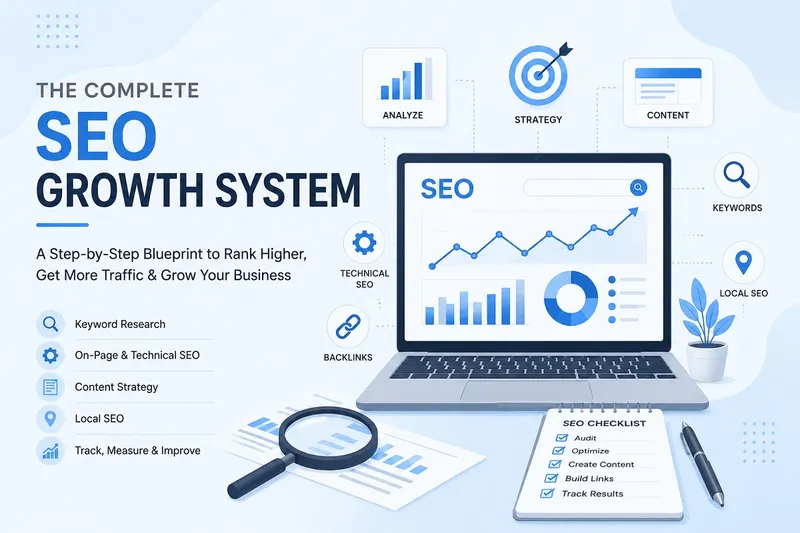
Introduction to SEO Growth Framework
In 2019, a small local accounting firm in Chennai had a clean website, good customer service, and reasonable pricing. Yet the business received almost no website leads.
The owner believed the problem was advertising.
However, the real problem was visibility.
Their website did not appear on Google for even basic searches like “GST filing service near me” or “small business tax consultant.” Competitors with weaker services ranked above them because they understood SEO better.
After improving website structure, fixing technical problems, creating helpful pages, and targeting local search intent, the company started receiving qualified leads every week without depending fully on paid ads.
This is how modern SEO works.
Search engine optimization is no longer about stuffing keywords into pages. Today, Google measures trust, page experience, usefulness, relevance, and business credibility before deciding who deserves visibility.
For small businesses and startups, SEO can become a long-term growth engine when done correctly.
This complete SEO blueprint explains:
- How search engines rank websites
- How to build an SEO-friendly business website
- How to create content that ranks and converts
- How technical SEO impacts visibility
- How local businesses can dominate nearby searches
- How to build long-term authority using topic clusters and E-E-A-T signals
This guide also acts as the main pillar article connected to detailed supporting topics like keyword research, Core Web Vitals, internal linking, schema markup, local SEO, and content optimization.
By the end, you will understand how to build a complete SEO growth system instead of chasing random SEO tricks.
Why SEO Matters More Than Ever for Businesses
Many startups invest heavily in:
- Paid advertisements
- Social media campaigns
- Influencer promotions
- Short-term traffic sources
These channels can generate quick visitors. However, once spending stops, traffic usually disappears.
SEO works differently.
A well-optimized website can continue bringing leads for months or even years from a single page.
For example:
- A plumbing company can rank for “emergency plumber near me”
- A SaaS startup can rank for “best CRM for freelancers”
- A digital agency can rank for “SEO services for ecommerce stores”
- A bakery can rank in Google Maps for local searches
This creates compounding growth.
According to multiple industry studies, organic search still remains one of the highest-converting traffic sources because users actively search for solutions with intent.
When someone searches:
- “best accountant for startup”
- “website design company near me”
- “how to improve ecommerce SEO”
they already need help.
That is why SEO traffic often converts better than random social traffic.
What Is an SEO Growth System?
Many businesses fail at SEO because they treat it as isolated tasks.
They publish blogs randomly. They add keywords without strategy. They ignore technical issues. They never update old content.
An SEO growth system connects every part together.
A complete SEO framework includes:
Core Parts of an SEO Growth System
SEO Foundations
This includes:
- Understanding how search engines work
- Keyword research
- Search intent analysis
- Competitor SEO research
Without this foundation, content often targets the wrong audience.
On-Page SEO
This improves individual pages using:
- SEO titles
- Meta descriptions
- Header structure
- Internal linking
- Image optimization
- Schema markup
These signals help Google understand content clearly.
Technical SEO
Technical SEO ensures search engines can:
- Crawl pages
- Index content
- Load pages quickly
- Access mobile-friendly layouts
Even strong content struggles if technical SEO is weak.
Content SEO
Content builds authority and trust.
This includes:
- Topic clusters
- Blog strategy
- E-E-A-T optimization
- Updating outdated pages
- Creating problem-solving content
Local SEO
For local businesses, Google Maps visibility is critical.
Local SEO includes:
- Google Business Profile optimization
- Reviews management
- Local citations
- Location pages
- Local keyword targeting
Authority Building
Modern SEO also depends on:
- Brand mentions
- Backlinks
- Trust signals
- Author credibility
- User engagement
Google wants evidence that real people trust your business.
How Search Engines Actually Work
Before improving rankings, businesses should understand how search engines function.
Google mainly follows three major steps:
Crawling
Google uses bots called crawlers to scan websites and collect information from pages, links, images, and files.
If your site structure is poor, crawlers may miss important pages.
This is why clean architecture and internal linking matter.
Indexing
After crawling, Google stores pages inside its search index.
Pages with:
- duplicate content
- blocked resources
- thin content
- technical problems
may not get indexed properly.
Ranking
Google then decides which pages deserve higher positions based on hundreds of signals, including:
- Relevance
- Content quality
- Page speed
- Mobile usability
- Backlinks
- Search intent match
- User experience
- Trustworthiness
This is where a complete SEO growth strategy becomes important.
Keyword Research: The Foundation of SEO Growth
Many business owners start SEO by writing content first and thinking about keywords later.
That usually leads to traffic with no conversions.
Keyword research should happen before creating pages because keywords reveal what customers actually want.
A startup founder may describe their service one way, while customers search differently on Google.
For example:
A company may say: “Cloud-based workflow automation solution”
But users may search: “task management software for small teams”
That difference changes traffic quality completely.
What Is Keyword Research?
Keyword research is the process of finding:
- What users search for
- How often they search
- Why they search
- Which keywords can generate leads or sales
- Which keywords competitors rank for
Good keyword research helps businesses build content around real demand instead of assumptions.
Types of SEO Keywords Every Business Should Target
A balanced SEO strategy uses multiple keyword categories.
Informational Keywords
Users want answers or education.
Examples:
- how search engines work
- what is local SEO
- how to improve website speed
- ecommerce SEO checklist
These keywords help attract early-stage visitors.
They also support topic authority and E-E-A-T signals.
Commercial Keywords
Users compare products or services before buying.
Examples:
- best CRM for startups
- top SEO tools for agencies
- affordable accounting software
- best hosting for WordPress SEO
These keywords often convert well because users are closer to decision-making.
Transactional Keywords
Users are ready to take action.
Examples:
- hire SEO agency
- buy email marketing software
- local plumber near me
- ecommerce SEO services
These keywords are highly valuable for lead generation.
Local SEO Keywords
Critical for local businesses.
Examples:
- dentist in Chennai
- bakery near Tiruvottiyur
- digital marketing agency in Coimbatore
Google Maps visibility heavily depends on local intent signals.
Long-Tail Keywords
Long-tail keywords usually contain 4 or more words.
Examples:
- SEO strategy for small ecommerce websites
- how to improve Google rankings for local business
- beginner guide to technical SEO for startups
These keywords often:
- Have lower competition
- Match clear intent
- Convert better
- Help new websites rank faster
Many small businesses ignore long-tail SEO opportunities even though they generate qualified traffic.
Search Intent: The Most Important SEO Signal
Google no longer ranks pages based only on keywords.
It ranks pages that best match user intent.
This means understanding why someone searches matters more than repeating keywords.
Four Main Types of Search Intent
Informational Intent
Users want knowledge.
Examples:
- what is schema markup
- how does SEO work
Best content format:
- Guides
- Tutorials
- Educational blogs
Commercial Investigation
Users compare options.
Examples:
- best SEO plugin for WordPress
- Ahrefs vs Semrush
Best content format:
- Comparison articles
- Reviews
- Case studies
Transactional Intent
Users are ready to buy or contact.
Examples:
- SEO consultant near me
- buy local SEO package
Best content format:
- Service pages
- Landing pages
- Product pages
Navigational Intent
Users want a specific brand or website.
Examples:
- Google Search Console login
- HubSpot pricing
Best content format:
- Brand pages
- Product pages
Why Search Intent Matters for Rankings
Imagine a user searches:
“best laptops for students”
If your page only lists laptop technical specifications without comparisons or buying advice, Google may not rank it highly.
Google studies:
- Click behavior
- Time spent on pages
- User satisfaction
- Search patterns
If users quickly leave your page, rankings may drop over time.
This is why matching intent improves both rankings and conversions.
Competitor SEO Analysis: Learning from Existing Winners
One of the fastest ways to build an SEO plan is studying websites already ranking on page one.
Google already shows which pages satisfy users.
Instead of guessing, businesses should analyze successful competitors carefully.
What to Analyze in Competitor SEO
Keyword Gaps
Find keywords competitors rank for but your website does not.
This reveals untapped traffic opportunities.
Example:
A local bakery may rank only for: “custom cakes Chennai”
But competitors may also rank for:
- birthday cakes delivery Chennai
- wedding cakes Chennai
- eggless cake shop near me
Each missing keyword represents potential traffic.
Content Structure
Study:
- Headings
- Content depth
- FAQ sections
- Images
- Internal links
- User experience
Top-ranking pages usually answer multiple related questions clearly.
Backlink Sources
Backlinks remain an important ranking factor.
Analyze:
- Which sites link to competitors
- Which industry directories mention them
- Which blogs reference them
This helps identify authority-building opportunities.
Content Freshness
Many businesses publish articles once and forget them.
However, competitors often update:
- statistics
- screenshots
- examples
- product details
- trends
Fresh content signals relevance.
Building an SEO-Friendly Website Structure
Website structure affects:
- Crawlability
- User experience
- Internal linking
- Rankings
A confusing structure can weaken SEO performance even with strong content.
Ideal SEO Website Architecture
A business website should follow a logical hierarchy.
Example:
Home
→ Services
→ Service Subpages
→ Blog
→ Topic Clusters
→ Contact
This structure helps:
- Users find information quickly
- Google understand topical relationships
- Link authority flow naturally
Why Topic Clusters Matter
Topic clusters help Google understand expertise depth.
Instead of writing unrelated blogs, businesses should organize content around core themes.
Example for an SEO agency:
Main Pillar Page
- Complete SEO Guide for Small Businesses
Supporting Cluster Articles
- Keyword Research Guide
- Internal Linking Strategy
- Technical SEO Checklist
- Image SEO Optimization
- Core Web Vitals Guide
- Local SEO Tips
- Schema Markup Tutorial
Each article links back to the main pillar page.
This creates strong topical relevance.
The Modern Content SEO Framework
Content today is not about publishing large amounts of articles.
Google rewards usefulness and expertise.
Businesses should focus on solving problems better than competitors.
The Best Content Types for SEO Growth
Educational Guides
Long-form helpful content builds authority.
Examples:
- Beginner SEO tutorials
- Industry explainers
- Step-by-step frameworks
Case Studies
Case studies build trust quickly.
Example:
“How a local restaurant increased organic traffic by 220% in 6 months”
Real examples strengthen E-E-A-T signals.
Service Pages
Many businesses ignore service page SEO.
Strong service pages should include:
- Clear solutions
- FAQs
- Local signals
- Trust indicators
- Real client outcomes
Comparison Articles
Comparison keywords often convert well.
Examples:
- Shopify vs WooCommerce SEO
- Local SEO vs paid ads
- Google Ads vs SEO for startups
Internal Linking: The Hidden SEO Multiplier
Internal linking is one of the most underused SEO strategies.
Yet it helps:
- Search engines crawl pages
- Distribute page authority
- Increase session duration
- Improve rankings
For example:
A blog about “Keyword Research” should naturally link to:
- Search Intent Guide
- Content SEO Framework
- Competitor Analysis Guide
This creates a connected SEO ecosystem.
Best Internal Linking Practices
- Link relevant pages naturally
- Use descriptive anchor text
- Avoid excessive links
- Link important pages frequently
- Update older articles with newer links
Good internal linking improves both SEO and user experience.
Common SEO Mistakes Small Businesses Make
Many websites fail not because of competition, but because of avoidable mistakes.
Most Common SEO Problems
Ignoring Technical SEO
Broken pages, slow speed, and crawl issues reduce rankings.
Writing Only for Search Engines
Keyword stuffing damages readability and trust.
Content should help humans first.
Publishing Thin Content
Short, shallow articles rarely perform well today.
Google prefers depth and usefulness.
No Content Strategy
Random publishing creates weak topical relevance.
Ignoring Mobile Users
Most searches now happen on mobile devices.
Poor mobile experience hurts rankings and conversions.
Not Updating Old Content
Refreshing older pages can often improve rankings faster than creating new pages.
On-Page SEO Blueprint for Higher Rankings
On-page SEO helps search engines understand individual pages clearly.
It also improves click-through rates, engagement, and conversions.
Many businesses focus only on publishing content. However, how content is structured matters just as much.
A well-written article with poor optimization may still struggle to rank.
Title Tags: Your First Ranking Opportunity
The title tag is often the first thing users see in Google search results.
It affects:
- Rankings
- Click-through rates
- Search relevance
- User expectations
A weak title can reduce traffic even when rankings are strong.
What Makes a Good SEO Title?
Strong title tags usually:
- Include the primary keyword naturally
- Stay clear and readable
- Create curiosity or value
- Match search intent
- Stay within visible character limits
Weak Example
“Home | ABC Solutions”
Better Example
“SEO Services for Small Businesses in Chennai”
The second title clearly explains the service and target audience.
Best Practices for Title Optimization
- Place important keywords near the beginning
- Avoid keyword repetition
- Keep titles human-friendly
- Include local intent where relevant
- Make every page title unique
Meta Descriptions: Improve Clicks from Search Results
Meta descriptions do not directly increase rankings, but they strongly influence clicks.
A compelling description can increase organic traffic without improving rankings.
Effective Meta Description Structure
Good meta descriptions usually:
- Explain page value quickly
- Include important keywords naturally
- Encourage action
- Match search intent
Example
“Learn practical SEO strategies for startups and small businesses to improve Google rankings, traffic, and conversions.”
Header Structure and Content Organization
Search engines analyze headings to understand content structure.
Clear headings also improve readability.
A good structure often follows:
- H1 for the main topic
- H2 for major sections
- H3 for supporting points
This helps users scan content quickly.
SEO-Friendly URL Structure
Simple URLs improve both usability and SEO clarity.
Weak URL
example.com/page?id=4572&cat=seoBetter URL
example.com/seo-growth-systemBest Practices for SEO URLs
- Keep URLs short
- Use readable words
- Include relevant keywords
- Avoid unnecessary numbers or symbols
- Maintain consistency
Clean URLs also improve sharing and trust.
Image SEO Optimization
Images improve engagement, but poorly optimized images can slow websites and reduce SEO performance.
Google also indexes images separately through Google Images.
That creates another traffic opportunity.
Important Image SEO Elements
File Names
Use descriptive names.
Weak Example
IMG002.jpg
Better Example
technical-seo-checklist.jpg
Alt Text
Alt text helps:
- Accessibility
- Image understanding
- Search visibility
Good alt text should describe the image naturally.
Image Compression
Large image files slow page speed.
Use modern formats like:
- WebP
- Optimized JPEG
- Compressed PNG
Faster pages improve user experience and rankings.
Schema Markup: Helping Search Engines Understand Context
Schema markup adds structured data to webpages.
It helps search engines understand:
- Business information
- Reviews
- Products
- FAQs
- Articles
- Events
- Services
Schema can also improve search appearance with rich results.
Useful Schema Types for Businesses
Local Business Schema
Helps search engines understand:
- Business name
- Address
- Opening hours
- Contact details
FAQ Schema
Can improve visibility for question-based searches.
Review Schema
Displays ratings in search results when implemented correctly.
Article Schema
Useful for blogs and educational content.
Technical SEO: The Engine Behind SEO Performance
Technical SEO ensures search engines can properly access and understand websites.
Even strong content can struggle if technical issues exist.
Many startups ignore technical SEO until rankings drop.
That often becomes expensive later.
Core Web Vitals and Website Performance
Google measures page experience using Core Web Vitals.
These metrics focus on real user experience.
Main Core Web Vitals Metrics
Largest Contentful Paint (LCP)
Measures loading performance.
Users expect pages to load quickly.
Interaction to Next Paint (INP)
Measures responsiveness.
Slow interactions create frustration.
Cumulative Layout Shift (CLS)
Measures visual stability.
Unexpected layout movement creates poor experiences.
How to Improve Core Web Vitals
Reduce Heavy Scripts
Too many plugins or scripts slow websites.
Optimize Images
Compressed images improve loading speed significantly.
Use Fast Hosting
Poor hosting affects performance even with optimized pages.
Enable Caching
Caching reduces server requests and improves speed.
Use Content Delivery Networks (CDNs)
CDNs distribute website assets globally for faster loading.
Crawlability and Indexing
Google must access pages before ranking them.
Poor crawlability prevents visibility.
Common Crawlability Problems
- Broken links
- Blocked pages
- Duplicate content
- Incorrect canonical tags
- Redirect chains
Regular SEO audits help identify these issues.
XML Sitemap Setup
An XML sitemap helps search engines find important pages.
Think of it as a roadmap for crawlers.
A good sitemap should:
- Include important URLs
- Exclude broken pages
- Update automatically
- Stay clean and organized
After creation, submit the sitemap through Google Search Console.
Robots.txt Guide
The robots.txt file controls crawler access.
Businesses use it to:
- Block sensitive areas
- Prevent duplicate crawling
- Control resource access
However, incorrect settings can accidentally block important pages from indexing.
This happens more often than many businesses realize.
Fixing SEO Errors Before They Damage Rankings
SEO errors accumulate over time.
Regular monitoring helps maintain visibility.
Common Technical SEO Errors
404 Errors
Broken pages create poor user experience.
Redirect or restore important pages properly.
Duplicate Content
Duplicate pages confuse search engines.
Canonical tags help solve this issue.
Redirect Problems
Too many redirects slow websites and weaken crawl efficiency.
Mobile Usability Issues
Mobile experience directly affects rankings.
Buttons, text, and layouts should work smoothly on smaller screens.
E-E-A-T: Building Trust That Google Can Measure
Google increasingly values:
- Experience
- Expertise
- Authoritativeness
- Trustworthiness
This is known as E-E-A-T.
Businesses with stronger trust signals often perform better long term.
How to Improve E-E-A-T Signals
Show Real Expertise
Use real-world examples, case studies, and practical insights.
Add Author Information
Clear author details improve credibility.
Build Transparent Business Information
Include:
- Contact pages
- Company details
- Privacy policies
- Terms pages
Earn Mentions and Backlinks
Industry references strengthen authority signals.
Keep Content Updated
Fresh information improves trust and relevance.
Local SEO Growth System for Small Businesses
Local SEO is essential for businesses serving specific cities or regions.
When users search:
- “restaurant near me”
- “SEO company in Chennai”
- “best dental clinic nearby”
Google prioritizes local relevance.
Google Business Profile Optimization
A properly optimized Google Business Profile can generate calls, visits, and leads consistently.
Important Optimization Steps
Complete Every Profile Section
Add:
- Services
- Website
- Business hours
- Categories
- Contact details
Add Real Photos
Businesses with genuine photos often receive better engagement.
Publish Updates Regularly
Google Business updates help maintain activity signals.
Maintain Consistent Information
Business name, address, and phone number should remain consistent across platforms.
Reviews Management Strategy
Reviews strongly influence local SEO and conversions.
Many users trust reviews almost as much as personal recommendations.
Best Practices for Reviews
- Request reviews politely
- Respond professionally
- Address negative feedback calmly
- Avoid fake reviews
- Encourage detailed customer experiences
Businesses that actively manage reviews often build stronger local trust.
Measuring SEO Performance Properly
SEO success should be measured using meaningful business metrics.
Not vanity numbers alone.
Important SEO Metrics to Track
Organic Traffic
Measure search-driven visitors over time.
Keyword Rankings
Track important commercial and transactional keywords.
Click-Through Rate (CTR)
Low CTR may indicate weak titles or descriptions.
Conversion Rate
Traffic alone is not enough.
Measure:
- Leads
- Calls
- Sales
- Form submissions
Bounce Rate and Engagement
Poor engagement may signal weak intent matching.
Essential SEO Tools for Businesses
Google Search Console
Tracks:
- Indexing
- Search visibility
- Technical issues
- Keyword performance
Google Analytics
Measures:
- Traffic
- Behavior
- Conversions
- User journeys
SEO Research Tools
Popular platforms include:
- Ahrefs
- Semrush
- Screaming Frog
- PageSpeed Insights
These tools help businesses identify opportunities and problems faster.
The Future of SEO: AI Search and GEO Optimization
Search behavior is changing rapidly.
AI-powered search experiences now summarize answers directly inside search results.
This creates new opportunities and challenges.
What Is GEO Optimization?
GEO means Generative Engine Optimization.
It focuses on improving visibility inside AI-generated search responses.
Businesses should create content that is:
- Clear
- Structured
- Trustworthy
- Well-organized
- Factually accurate
AI systems often prefer content with strong topical depth and credibility signals.
How Businesses Can Prepare for AI Search
Build Strong Topic Authority
Comprehensive content ecosystems perform better than isolated pages.
Use Structured Data
Schema markup helps AI systems understand content context.
Answer Questions Clearly
FAQ-style content improves visibility in conversational search.
Focus on Real Expertise
Generic AI-written content without practical value may struggle over time.
Real-world experience matters more than ever.
Complete SEO Action Plan for Small Businesses and Startups
SEO becomes manageable when broken into clear steps.
Many businesses fail because they try to do everything at once.
Instead, focus on building a stable SEO system gradually.
Phase 1: Build the Foundation
The first stage focuses on technical stability and SEO structure.
Without a proper foundation, later efforts become weaker.
Step 1: Set Up Essential SEO Tools
Start with:
- Google Search Console
- Google Analytics
- Bing Webmaster Tools
- PageSpeed Insights
These tools provide visibility into:
- Traffic
- Indexing
- Technical errors
- User behavior
- Performance issues
Step 2: Fix Technical Problems
Before publishing large amounts of content:
- Fix broken links
- Improve mobile usability
- Compress images
- Improve website speed
- Create XML sitemap
- Configure robots.txt properly
Technical cleanup often creates quick ranking improvements.
Step 3: Build SEO-Friendly Website Architecture
Organize pages logically.
Example structure:
Home
→ Services
→ Service Subpages
→ Blog Categories
→ Topic Clusters
→ Contact
This improves both user experience and crawl efficiency.
Phase 2: Build Keyword and Content Strategy
After technical setup, focus on content planning.
Step 4: Create Keyword Clusters
Instead of targeting single isolated keywords, group related searches together.
Example Cluster
Main Topic:
- Local SEO for Small Businesses
Supporting Topics:
- Google Business Profile optimization
- Local citations
- Reviews strategy
- Local keyword research
- Google Maps ranking factors
This builds topical authority faster.
Step 5: Match Content to Search Intent
Different keywords require different page formats.
| Intent Type | Best Content Format |
|---|---|
| Informational | Guides and tutorials |
| Commercial | Comparison articles |
| Transactional | Service pages |
| Local | Location pages |
Intent alignment improves rankings and conversions.
Step 6: Create High-Quality Pillar Content
Pillar pages act as the main authority hub for major topics.
This article itself is an example of pillar content.
Strong pillar pages usually:
- Cover topics deeply
- Connect supporting articles
- Include internal links
- Answer multiple related questions
- Stay updated regularly
SEO Content Publishing Workflow
Consistency matters more than random publishing bursts.
A repeatable workflow improves quality and scalability.
Recommended SEO Publishing Process
Research
Identify:
- Search demand
- Competitor gaps
- User intent
- Related questions
Planning
Create:
- Heading structure
- Internal link opportunities
- FAQs
- Content angle
Writing
Focus on:
- Clarity
- Practical value
- Readability
- Real examples
- User satisfaction
Optimization
Improve:
- SEO title
- Meta description
- Images
- Schema markup
- Internal links
Publishing
After publishing:
- Submit URL for indexing
- Share through social channels
- Monitor performance
Updating
Update important pages every few months with:
- Fresh examples
- New data
- Better visuals
- Improved explanations
Content freshness supports long-term rankings.
90-Day SEO Roadmap for Startups
SEO takes time, but structured execution creates measurable progress.
First 30 Days: Setup and Research
Focus Areas:
- Technical SEO audit
- Keyword research
- Competitor analysis
- Website structure
- Google Search Console setup
- Sitemap submission
- Core page optimization
Goal: Create a stable SEO foundation.
Days 31–60: Content and On-Page SEO
Focus Areas:
- Publish pillar content
- Create supporting blogs
- Optimize service pages
- Improve internal linking
- Add schema markup
- Optimize images
Goal: Build topical authority and search relevance.
Days 61–90: Authority and Growth
Focus Areas:
- Build backlinks
- Improve local SEO
- Collect reviews
- Update older pages
- Analyze rankings
- Improve conversion elements
Goal: Strengthen trust and improve traffic quality.
Link Building Strategy for Long-Term Authority
Backlinks still matter because they act as trust signals.
However, quality matters far more than quantity.
A few strong links can outperform hundreds of weak ones.
Safe and Effective Link Building Methods
Create Useful Resources
Useful tools, guides, and original research naturally attract links.
Guest Posting
Write useful articles for relevant industry websites.
Focus on relevance and quality.
Local Citations
For local businesses, directory mentions help build trust.
Examples include:
- Google Business Profile
- Justdial
- IndiaMART
- Sulekha
Build Shareable Content
Practical content often gains links naturally.
Examples:
- Industry statistics
- Case studies
- Checklists
- Templates
SEO Budgeting for Small Businesses
Many startups assume SEO requires huge budgets.
In reality, smart prioritization matters more.
Where Businesses Should Invest First
Technical Stability
Fast hosting and mobile-friendly design should come early.
Content Quality
One excellent article often performs better than ten weak posts.
SEO Tools
Even basic SEO tools save time and improve decision-making.
Professional Expertise
Some areas like technical SEO or schema implementation may require specialists.
SEO Is a Long-Term Business Asset
SEO rarely produces overnight results.
However, once authority builds, traffic compounds over time.
This creates:
- Lower customer acquisition cost
- Stable lead generation
- Better brand trust
- Higher search visibility
- Long-term business growth
Businesses that remain consistent usually outperform competitors that chase shortcuts.
Important SEO Trends Businesses Should Watch
Search engines continue changing rapidly.
Businesses should adapt early instead of reacting late.
AI-Powered Search Experiences
Search engines increasingly summarize answers directly.
Content should remain:
- Structured
- Helpful
- Experience-driven
- Factually clear
Video SEO Growth
Video visibility continues increasing in search results.
Businesses should consider:
- Tutorials
- Product demos
- Educational explainers
Voice Search Optimization
Conversational search queries are increasing.
Example:
Instead of: “best SEO tools”
Users may ask: “What are the best SEO tools for small businesses?”
Natural language optimization matters more now.
Brand Authority Signals
Google increasingly values recognizable businesses and trusted authors.
Strong branding supports SEO performance indirectly.
Final Thoughts
SEO is no longer a simple checklist.
It is a connected growth system built on:
- Technical health
- Helpful content
- User experience
- Trust
- Relevance
- Consistency
Small businesses and startups do not need massive budgets to compete.
They need structure, patience, and strategic execution.
The businesses that win in search are usually not the loudest.
They are the most useful.
When your website consistently helps users solve problems, answers questions clearly, loads quickly, and builds trust over time, search visibility improves naturally.
SEO rewards businesses that think long term.
That is why a well-built SEO system becomes one of the most valuable digital assets a company can own.
References & Further Reading
The following official resources, documentation pages, and industry references can help readers learn more about SEO fundamentals, technical optimization, search performance, structured data, and website growth strategies discussed in this guide.
- Google SEO Starter Guide — Official beginner-friendly SEO documentation from Google covering search optimization fundamentals and website best practices.
- Google Search Console — Official Google platform for monitoring indexing, keyword performance, crawl issues, and website visibility in search results.
- Google PageSpeed Insights — Performance analysis tool for testing website speed, Core Web Vitals, mobile usability, and page experience improvements.
- Google Structured Data Documentation — Official guide explaining schema markup, rich results, and how structured data improves search understanding.
- Robots.txt Introduction — Google documentation explaining how robots.txt controls crawler access and affects website indexing behavior.
- XML Sitemap Guidelines — Official sitemap documentation showing how websites help search engines discover and index important pages.
- Google Business Profile Help — Official local SEO resource for optimizing business listings, improving Google Maps visibility, and managing customer reviews.
- Google Search Central Blog — Latest updates, ranking guidance, algorithm discussions, and search-related announcements directly from Google.
- Ahrefs SEO Blog — Industry-recognized SEO learning resource covering keyword research, link building, technical SEO, and content strategies.
- Moz Beginner's Guide to SEO — Comprehensive educational guide explaining search engine optimization concepts, ranking factors, and SEO strategy basics.
Frequently Asked Questions
What is the best SEO strategy for small businesses?
The best SEO strategy combines keyword research, technical SEO, high-quality content, local SEO, internal linking, and consistent optimization to improve rankings, traffic, and lead generation over time.
How long does it take for SEO to improve Google rankings?
SEO usually takes several months to show strong results because search engines need time to crawl, index, and evaluate website quality, authority, user engagement, and content relevance.
Why is keyword research important for SEO?
Keyword research helps businesses understand what customers search for online, allowing websites to target high-intent topics that attract qualified traffic and improve conversions naturally.
What is the difference between on-page SEO and technical SEO?
On-page SEO focuses on content optimization, titles, headings, and internal links, while technical SEO improves crawlability, indexing, website speed, and mobile usability.
How does local SEO help small businesses grow?
Local SEO improves visibility in nearby searches and Google Maps results, helping businesses attract customers searching for services within specific cities or local areas.
What are Core Web Vitals in SEO?
Core Web Vitals are performance metrics used by Google to measure page speed, responsiveness, and visual stability, which directly impact user experience and rankings.
Why are backlinks important for SEO rankings?
Backlinks act as trust signals that show search engines other websites value your content, helping improve authority, credibility, and overall search visibility.
How often should website content be updated for SEO?
Important website pages and blog posts should be reviewed and updated regularly with fresh information, improved structure, and current examples to maintain rankings and relevance.
Can startups rank on Google without a large SEO budget?
Yes, startups can rank well by targeting long-tail keywords, building helpful content, improving technical SEO, and focusing on niche or local search opportunities consistently.
What is E-E-A-T and why does it matter in SEO?
E-E-A-T stands for Experience, Expertise, Authoritativeness, and Trustworthiness, which are important quality signals Google uses to evaluate content credibility and reliability.



Comments Section