

Imagine two people earning the same ₹50,000 every month.
The first person gets all ₹50,000 from a job. If the job disappears, the main income source disappears too.
The second person earns ₹35,000 from a job, ₹5,000 from a small business, ₹3,000 from investments, ₹4,000 from rent, and ₹3,000 from other assets.
Both people earn ₹50,000.
But their financial lives are very different.
The second person has built several income streams.
This does not mean that everyone needs seven sources of income immediately. In fact, trying to build all seven at once can create unnecessary stress. A better approach is to understand how each type works and slowly add income sources that match your money, skills, time, and goals.
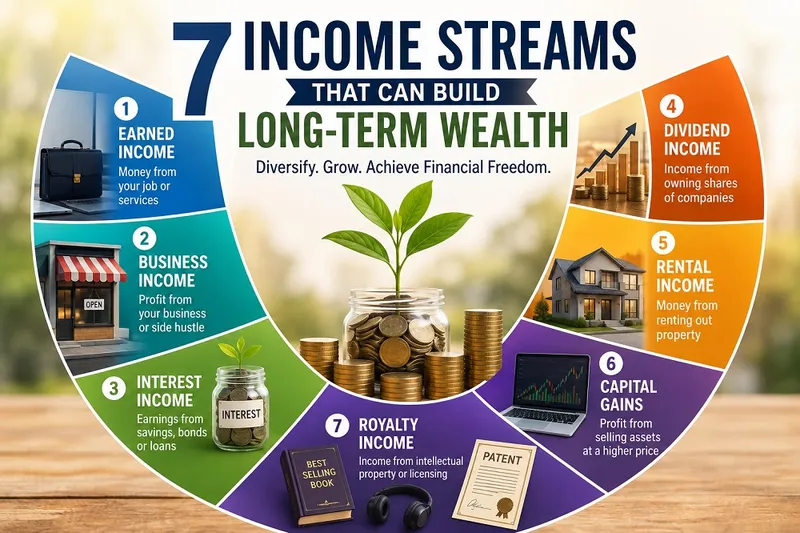
The seven income streams commonly discussed in personal finance are:
- Earned income
- Business or profit income
- Interest income
- Dividend income
- Rental income
- Capital gains
- Royalty income
Each one works differently. Some require your time. Others can continue with less daily work once the asset or system is in place.
There is also an important point to remember: these seven categories are a useful wealth-building framework, not a universal tax classification. Tax rules differ by country, and some income may be treated differently for tax purposes.
So, let’s look at each income stream in simple terms.
Earned Income: Money From Your Work
Earned income is the most common income source.
You work, and someone pays you for your time, skills, or services.
This includes:
- Salary
- Wages
- Commissions
- Bonuses
- Freelance payments
- Professional fees
- Payments for services
For example, a teacher receives a monthly salary for teaching students. A driver receives money for providing driving services. A software developer receives payment for building software.
This is usually where people start.
Why earned income matters
Earned income gives you the money needed to build the other income streams.
Suppose you earn ₹40,000 per month.
You spend ₹30,000 and have ₹10,000 left.
That ₹10,000 can potentially go toward investments, a business, property, or another asset.
In this way, earned income can become the starting point for building wealth.
The weakness of earned income
There is one major limitation.
Your income is usually connected to your ability to work.
If you stop working, your salary or service income may stop as well.
That is why many people eventually try to turn part of their earned income into assets that can produce other forms of income.
Business Income: Making Money From a Business
Business income comes from owning and operating a business.
The basic idea is simple:
Revenue − business expenses = profit
For example, imagine someone sells handmade products online.
The business makes ₹1,00,000 in sales in one month.
The owner spends ₹70,000 on materials, delivery, advertising, software, and other costs.
The remaining ₹30,000 is profit before applicable taxes and other adjustments.
That ₹30,000 is very different from the ₹1,00,000 in sales.
Business income can start small
A business does not have to begin with a large office, employees, or expensive equipment.
Someone might start with:
- Freelance writing
- Web development
- Online courses
- Digital products
- Consulting
- A small online store
- Photography
- Repair services
- Local services
- Content websites
A person can start by selling a skill and later build a larger business around it.
Business income has higher responsibility
Business income can grow faster than a salary in some cases, but it also comes with risk.
Customers can leave.
Costs can rise.
Sales can fall.
Competitors can appear.
Taxes, licenses, staff costs, technology costs, and other expenses can also affect the final profit.
So business income should not be viewed as “easy passive income.”
A successful business often requires serious work before it can produce consistent profit.
Interest Income: Getting Paid for Your Money
Interest income is money earned when your money is placed in an interest-paying asset or account.
Common examples include:
- Bank fixed deposits
- Savings accounts
- Bonds
- Certain government securities
- Some debt instruments
For example, suppose you place ₹5,00,000 in an investment that pays 7% annual interest.
Ignoring taxes and assuming the rate stays unchanged, the simple annual interest would be about ₹35,000.
Your original money remains invested, while the investment produces interest.
Why interest income is useful
Interest income can be useful for people who want relatively predictable cash flow and lower risk than many market-linked investments.
This is one reason fixed deposits and bonds are popular among conservative investors.
However, “lower risk” does not mean “no risk.”
Different investments have different levels of:
- Credit risk
- Interest-rate risk
- Inflation risk
- Liquidity risk
- Market risk
A bank deposit, government bond, corporate bond, and debt fund are not identical products.
The inflation problem
Suppose your investment earns 6% but inflation is 5%.
Your money has grown in rupee terms, but its purchasing power has grown much less.
That is why interest income can be useful for stability while growth-oriented assets may play a different role in a long-term plan.
Dividend Income: Getting Paid as a Shareholder
When you buy shares of a company, you become a part-owner of that company.
Some companies distribute part of their profits to shareholders.
These payments are called dividends.
For example, imagine you own 100 shares of a company.
If the company declares a dividend of ₹10 per share, your dividend would be ₹1,000 before any applicable taxes or charges.
The important point is that you can receive this money without selling your shares.
Dividends are not guaranteed
This is one of the biggest misunderstandings about dividend income.
A company can:
- Increase its dividend
- Keep it unchanged
- Reduce it
- Stop paying it
A high dividend yield does not automatically mean a stock is a good investment.
Sometimes a stock has a high dividend yield because its share price has fallen sharply.
Therefore, investors should look at the company’s earnings, cash flow, debt, business quality, dividend history, and future prospects rather than looking only at the dividend percentage.
Dividend income and long-term investing
Dividend-paying companies can form part of a long-term investment strategy.
However, investors should remember that a company’s total return can come from both dividends and changes in the share price.
A company that pays no dividend may still create value by reinvesting its profits into business growth.
So dividend income is one part of the bigger investment picture.
Rental Income: Making Money From Property
Rental income comes from allowing someone else to use your property in exchange for regular payments.
Examples include:
- Residential houses
- Apartments
- Shops
- Offices
- Warehouses
- Commercial buildings
- Certain land arrangements
Imagine you own a small apartment and rent it for ₹15,000 per month.
Your gross rental income would be ₹1,80,000 per year.
But that is not necessarily your actual profit.
You may have expenses such as:
- Property maintenance
- Repairs
- Property taxes
- Insurance
- Vacancies
- Brokerage
- Loan interest
- Society or building charges
After these costs, the amount left in your pocket may be much lower.
Rental income is not completely passive
People often call rent “passive income,” but property ownership can require work.
A tenant may call you about a repair.
A property can remain vacant.
A payment can be delayed.
A major repair can suddenly cost a large amount.
Professional property management can reduce some of the daily work, but it also adds another expense.
Property can provide two possible returns
Real estate can potentially produce:
- Rental income while you own the property
- Capital gains if you later sell it for more than your adjusted cost
This combination is one reason property has remained popular as a wealth-building asset.
Still, property prices do not always rise, and real estate can be difficult to sell quickly.
Capital Gains: Making Money When an Asset Rises in Value
Capital gains are different from the other income streams.
You generally make a capital gain when you sell an asset for more than your cost, after considering applicable costs and adjustments.
Examples can include:
- Stocks
- Mutual funds
- Exchange-traded funds
- Real estate
- Certain bonds or other investments
- Collectibles and other assets
Suppose you buy shares for ₹1,00,000.
Later, you sell them for ₹1,40,000.
Your basic gain is ₹40,000 before considering transaction costs and applicable tax rules.
That is a capital gain.
Capital gains can create large wealth
Many long-term investors build wealth mainly through asset appreciation.
Consider someone who regularly buys quality investments and holds them for many years.
The investment may grow from:
₹1 lakh → ₹2 lakh → ₹4 lakh → ₹8 lakh
The investor does not necessarily receive this growth as regular cash.
The value exists in the asset.
When the investor sells, the increase can become a realized capital gain.
Capital gains are not guaranteed income
This distinction matters.
A ₹10 lakh portfolio showing a ₹2 lakh profit on paper has an unrealized gain.
You have not actually sold the investment.
If the market later falls, that gain can shrink or disappear.
So capital gains are better viewed as wealth growth through asset appreciation, rather than dependable monthly income.
Royalty Income: Getting Paid for Something You Created
Royalty income can come from intellectual property or other rights that you own.
For example, a creator may receive money when another person or company pays to use their work.
Possible sources include:
- Books
- Music
- Photographs
- Software
- Patents
- Designs
- Trademarks
- Digital content
- Licensed inventions
Imagine an author writes a book.
A publisher sells copies and pays the author according to the terms of their agreement.
The author created the work once, but the work can potentially generate payments over a long period.
The same basic idea can apply to music, software, inventions, designs, and other intellectual property.
Royalty income can be powerful for creators
A normal service often works like this:
Work once → get paid once
A royalty-based model can sometimes work differently:
Create an asset → allow others to use it → receive payments according to the agreement
That does not mean royalties are automatic money.
Creating something valuable can take months or years. Some creations may never generate meaningful income.
Copyright rules, contracts, licensing terms, ownership, and taxes also matter.
How the 7 Income Streams Fit Together
The real value comes from understanding how these income streams can work together.
Imagine someone starts with a job.
Stage 1: Earned income
They earn ₹50,000 per month from employment.
They use part of their income for living costs and save the rest.
Stage 2: Interest income
They build an emergency fund and place some money in suitable interest-bearing assets.
Now part of their money produces interest.
Stage 3: Dividend income and capital gains
They invest another portion into suitable long-term investments.
Those assets may provide dividends and may also rise in value.
Stage 4: Business income
Later, they start a small online business using a skill they already have.
The business produces additional profit.
Stage 5: Royalty income
The person creates an online course, book, software product, design, or another intellectual asset.
If people pay to use or buy it, that asset may create another source of income.
Stage 6: Rental income
After building enough capital, the person may decide that owning a rental property fits their financial plan.
Now rent becomes another possible source.
The important lesson is not that everyone must own seven income streams.
The lesson is that your financial life does not have to depend forever on one source of money.
Active Income vs Passive Income
The seven income streams can also be viewed through another simple question:
How much of your time is required to keep the income going?
More active income
These usually require regular work:
- Salary
- Freelancing
- Business operations
- Professional services
Less active income
These may require less daily work after the asset or system is established:
- Interest
- Dividends
- Rental income
- Certain royalties
- Capital appreciation
But the word “passive” can be misleading.
A rental property needs management.
Investments need monitoring.
A business needs attention.
A book needs marketing.
Even interest income requires capital in the first place.
So it is better to think about time required, rather than assuming that any income source requires no work.
Which Income Stream Should You Build First?
There is no single answer for everyone.
Your first step should usually be the income source that matches your current situation.
If you have a job but little savings
Focus on increasing earned income and controlling expenses.
Learning a valuable skill can sometimes increase your earning ability more than chasing a small investment return.
If you have savings
You can consider suitable investments that may produce interest, dividends, or long-term capital growth.
Your emergency fund and financial needs should come before taking unnecessary investment risk.
If you have a useful skill
A small business or freelance service may be a practical second income stream.
You do not necessarily need a large amount of money to start selling a skill.
If you have substantial capital
You may have more choices, including bonds, deposits, stocks, funds, real estate, or other assets that fit your risk level.
The key is to understand what you are buying rather than choosing an asset simply because it produces income.
If you are a creator
Books, music, courses, software, designs, photographs, and other intellectual property may create royalty or licensing opportunities.
You Do Not Need Seven Income Streams at Once
This is perhaps the most important lesson.
Seeing a list of seven income streams can make wealth building look like a giant project.
It does not have to be.
Start with one.
For example:
Job → savings → investments → second income → business → more assets
Over time, one income stream can help fund another.
A person with ₹10,000 in savings does not need to think about buying a commercial building.
Likewise, someone with a successful business does not need to start another five businesses just to say they have multiple income streams.
The goal is not to collect income streams.
The goal is to build a stronger financial system.
Why Multiple Income Sources Can Reduce Financial Dependence
Imagine a household receives 100% of its income from one job.
If that job disappears, the household immediately faces a major problem.
Now imagine the same household receives:
- 60% from employment
- 15% from business profit
- 10% from investments
- 10% from rent
- 5% from other sources
If one source falls, the household may still have money coming from elsewhere.
That can provide more financial flexibility.
However, diversification does not remove risk.
A recession can affect jobs and businesses at the same time.
A market crash can reduce investment values.
A property can remain vacant.
Interest rates can change.
Therefore, multiple income streams should be viewed as a way to reduce dependence on one source, not as a guarantee against financial loss.
The Difference Between Income and Wealth
This distinction is easy to miss.
Someone can earn ₹2 lakh every month and still have little wealth if they spend almost everything.
Another person may earn ₹60,000 per month but regularly buy productive assets and build savings.
Over many years, the second person may build a stronger financial position.
Income is the money coming in.
Wealth is the value of the assets you own minus what you owe.
That is why wealth building is not simply about finding more ways to earn money.
It is also about what you do with the money after you earn it.
A Simple Example of Building Multiple Income Streams
Consider a fictional person named Arun.
Arun earns ₹45,000 per month from his job.
Instead of immediately trying to start six side businesses, he follows a simple path.
First, he builds an emergency fund.
Then he invests a part of his monthly savings.
Over time, his investments produce some interest, dividends, and capital growth.
Later, Arun starts a small weekend service based on a skill he already has.
The extra business profit allows him to invest more.
Years later, he may have enough capital to consider property or another asset.
He also creates a digital product that earns occasional royalty or licensing payments.
Nothing happened overnight.
His seven income streams did not appear on the same day.
They developed one after another.
That is how wealth building often works in real life: small financial decisions repeated for years can create a much larger result.
Common Mistakes When Building Income Streams
Multiple income sources sound attractive, but there are several traps to avoid.
Chasing too many things
Starting five side hustles at once can leave you exhausted and make none of them successful.
Confusing revenue with profit
A business making ₹10 lakh in sales does not mean the owner earned ₹10 lakh.
Expenses matter.
Treating dividends as guaranteed
Companies can reduce or stop dividends.
Assuming property always rises
Real estate prices can fall or remain flat for long periods.
Ignoring taxes
Different types of income can have different tax treatment depending on the country and the nature of the transaction.
Taking too much debt
Borrowing money to buy assets can increase returns, but it can also increase losses.
Chasing “passive income”
Many income streams require work, capital, maintenance, or risk.
The right question is not “Can I make money without doing anything?”
A better question is:
“Can I build assets and systems that reduce my dependence on active work over time?”
How to Start Building Your Own Income Streams
You can keep the process simple.
Step 1: Protect your main income
Your job, profession, or existing business may be your most important financial asset today.
Do not put it at unnecessary risk while chasing a new income source.
Step 2: Create savings
Before taking major investment risks, build a cash reserve suitable for your personal needs.
Step 3: Invest regularly
Choose investments based on your goals, time period, risk tolerance, and financial situation.
Step 4: Build a second skill-based income
If you have a skill that people will pay for, consider freelancing or a small business.
Step 5: Buy productive assets
Over time, aim to own assets that can potentially produce cash flow or appreciate in value.
Step 6: Reinvest part of the income
Instead of spending every extra rupee, use some of it to build the next asset.
Step 7: Review your plan
Income streams can change.
A business can become less profitable.
A dividend can be reduced.
An investment can underperform.
A property can become expensive to maintain.
Reviewing your financial plan from time to time helps you make better decisions.
The Bigger Picture: From One Paycheck to a Financial System
The seven income streams are not seven magic buttons that create wealth.
They are seven ways money can reach you.
Earned income pays you for your work.
Business income rewards successful business activity.
Interest pays you for providing capital.
Dividends can distribute part of a company’s profits to shareholders.
Rental income comes from property use.
Capital gains can result when assets increase in value and are sold.
Royalty income can come from allowing others to use intellectual property.
Each has advantages and risks.
The smartest approach is not to chase every possible source. Instead, build gradually.
Start with the income source you already have.
Strengthen it.
Save part of what you earn.
Turn some savings into suitable assets.
Then allow those assets and skills to create additional opportunities.
Over many years, the goal is to move from depending entirely on your time to owning a growing mix of income-producing assets.
Conclusion
Building wealth rarely happens because of one brilliant investment or one lucky business idea.
For most people, it is a long process.
You earn money, save some of it, buy assets, build skills, create businesses, and give your money time to grow.
The seven income streams - earned income, business income, interest, dividends, rental income, capital gains, and royalties - give you a useful map of the different ways money can be made.
You do not need all seven.
You do not need to start today with a huge amount of money.
Start where you are.
Build one strong income source first. Then use part of that income to create the next one.
Over time, the aim is simple: make your money depend less on one paycheck and give yourself more than one path toward financial security.
References & Further Reading
The following sources provide reliable background on interest, dividends, capital gains, and rental income. They can help readers understand how different income types work and why the tax treatment of investment and property income can vary by country.
- Internal Revenue Service - Interest Received - Explains interest income from bank accounts, bonds, and other interest-bearing investments, including basic tax reporting rules.
- Internal Revenue Service - Dividends and Corporate Distributions - Provides background on dividends paid to shareholders and explains different types of corporate distributions.
- Internal Revenue Service - Capital Gains and Losses - Explains how gains and losses can arise when investment and other capital assets are sold for more or less than their adjusted cost.
- Internal Revenue Service - Rental Income and Expenses - Covers rental income and common expenses associated with income-producing property, helping readers understand why gross rent is not the same as rental profit.
Frequently Asked Questions
What are the 7 main income streams?
The seven main income streams are earned income, business or profit income, interest income, dividend income, rental income, capital gains, and royalty income. Each works differently and carries its own level of risk, effort, and possible return.
Which income stream is the most common?
Earned income is the most common income stream because most people receive money by working for an employer or providing services. Salary, wages, commissions, bonuses, and freelance payments are common examples of earned income.
Can one person have all 7 income streams?
Yes, one person can have all seven income streams, but there is no need to build them all at once. A person can start with earned income, then gradually add investments, business income, rental income, or royalty income as their finances allow.
Which income streams are considered passive income?
Interest, dividends, rental income, and some royalty income are often called passive income, but the term can be misleading. These sources may still require capital, management, research, maintenance, or regular attention to keep producing money.
Is dividend income guaranteed every year?
No, dividend income is not guaranteed. Companies can increase, reduce, or completely stop dividends depending on their profits, cash flow, business plans, and financial condition. Investors should not choose a stock only because it offers a high dividend.
How do capital gains create wealth?
Capital gains can create wealth when an asset becomes more valuable over time and is later sold for more than its purchase cost, after considering relevant costs and tax rules. Stocks, funds, property, and other assets can potentially generate capital gains.
Can rental income be a good source of regular income?
Rental income can provide regular cash flow when a property has reliable tenants, but it is not guaranteed. Owners may face vacancies, repairs, taxes, maintenance costs, loan payments, and other expenses that reduce the actual profit from the property.
How can a beginner start building multiple income streams?
A beginner can start by strengthening their main income, building savings, and investing regularly. Once their financial base becomes stronger, they can consider a side business, suitable investments, rental assets, or intellectual property based on their skills and available capital.
What is the difference between income and wealth?
Income is money that you receive from work, business, investments, property, or other sources. Wealth is the value of what you own after subtracting what you owe. A high income does not automatically create wealth if most of the money is spent.
Do I need all 7 income streams to become wealthy?
No, you do not need all seven income streams to build wealth. Many people can build strong finances through a combination of earned income, disciplined saving, and long-term investing. The main goal is to reduce dependence on a single source over time.



Comments Section